New Thing Nurse

Let us help with your new thing.

  • NTN Consults
  • Home
  • About
    • Who is the New Thing Nurse?
    • NEW THING NURSE
    • DISCLAIMERS
  • TEMPLATES
  • Services
    • NURSING STUDENTS & NEW GRADS
    • EXPERIENCED NURSES
    • NURSE PRACTITIONERS
    • WORKSHOPS & EVENTS
    • FAQ: HAVE A QUESTION? READ THIS
    • REVIEWS
  • ADVOCACY
  • BLOG
  • RESOURCES
    • FAVORITES
    • PPE CARE PACKAGE PROJECT
    • MENTAL HEALTH
    • VIOLENCE AGAINST HEALTHCARE WORKERS
  • CONTACT

Closing the Communication Gap in Nursing

June 18, 2026 by Sarah Wells

By: Sarah K. Wells MSN RN CEN CNL

Discover how AI-powered nurse communication training bridges the gap between school and the bedside to reduce medical errors and improve patient satisfaction.

When a breakdown in care occurs, it is rarely due to a lack of clinical knowledge. The Joint Commission Sentinel Event Data Annual Review consistently highlights that hospital adverse events - including falls, treatment delays, and wrong-site surgeries - are overwhelmingly rooted in communication failures during handovers, care transitions, and acute emergencies.

To protect our patients and stabilize our workforce, we must fundamentally reshape how we build and sustain clinical communication. High-fidelity communication training is no longer a "soft skill" luxury; it is a clinical, financial, and educational imperative. To be effective, this training must span the entire developmental continuum: from undergraduate nursing education to formal residency programs for new graduates.

The Ripple Effect

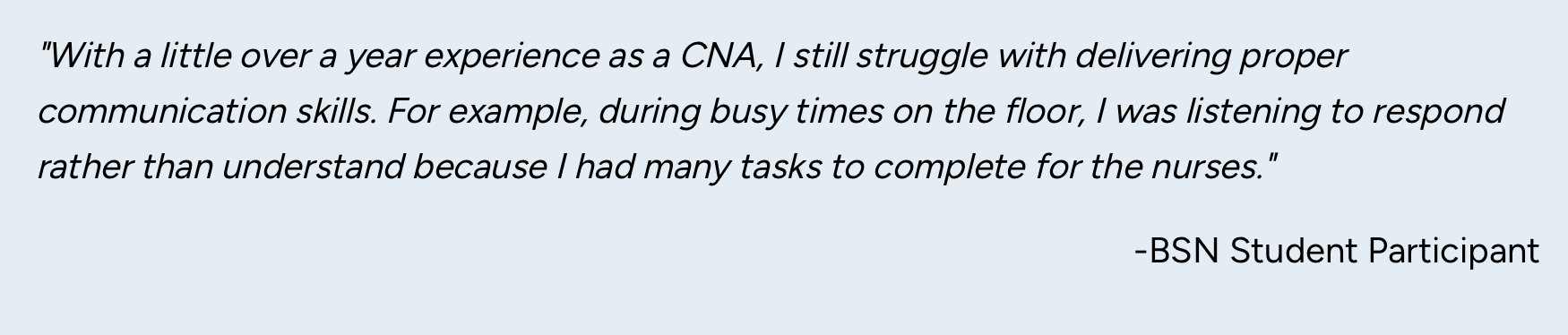
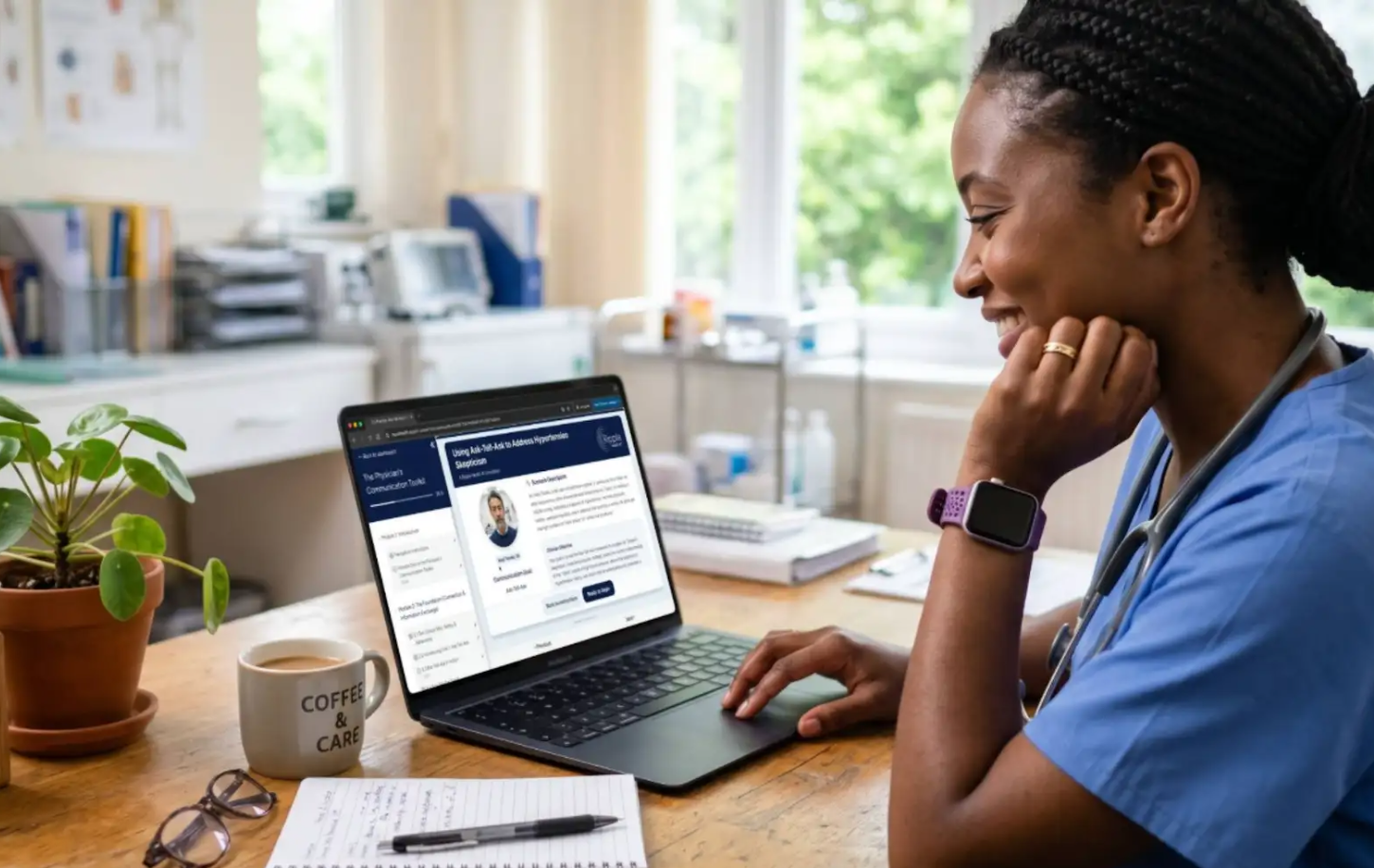
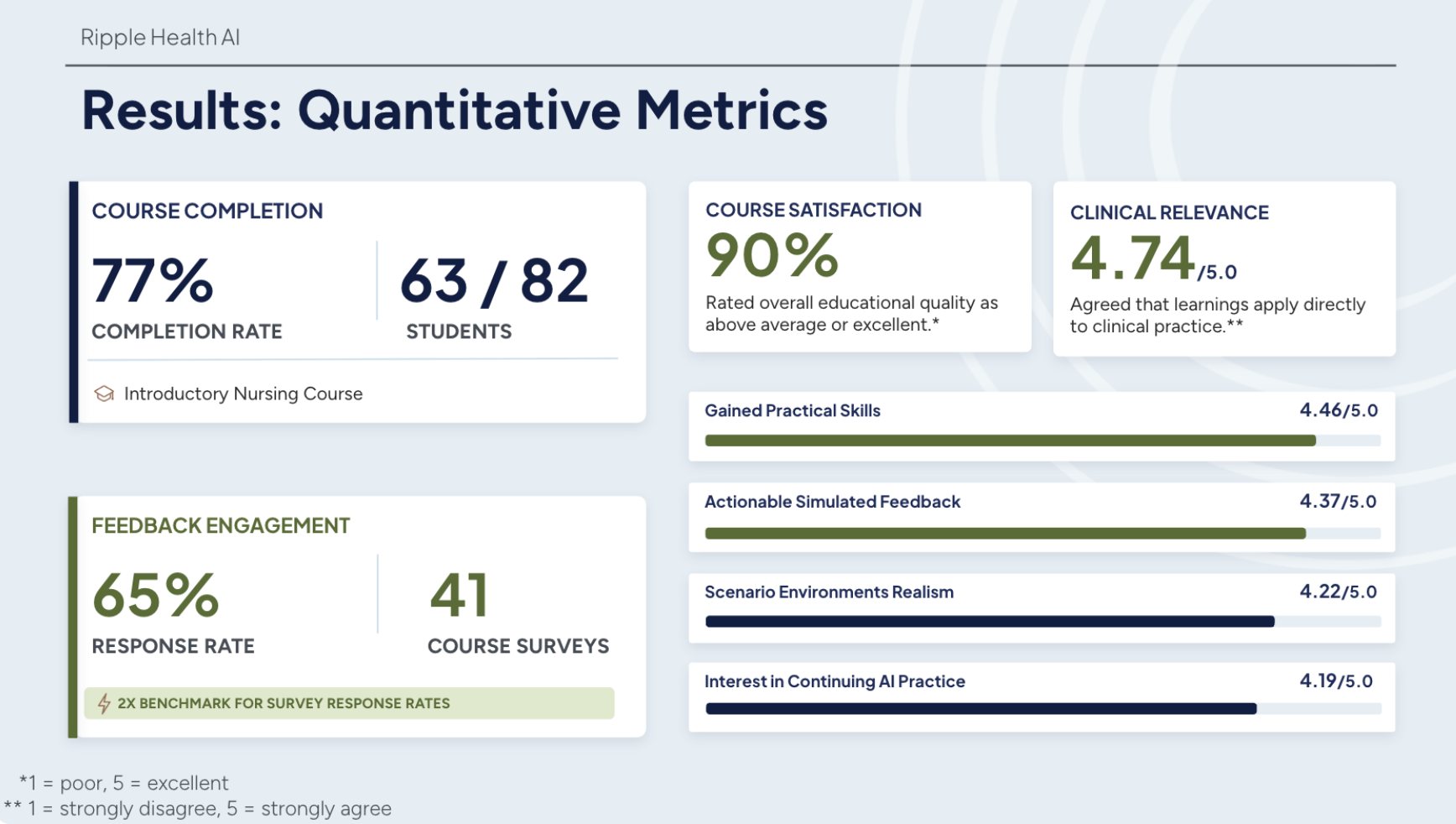
To bridge these academic and clinical gaps, Ripple Health AI delivers tailored solutions designed to support, scale, and standardize this vital work. Recent feedback highlights the tangible, positive practice perceptions experienced by nursing students using our advanced, interactive communication training tools.

In May 2026, pre-licensure students in a Bachelor of Science in Nursing (BSN) program at a top-tier university on the West Coast utilized the Ripple Health AI platform. Students completed the specialized course, “Communicating with Patients: The 4 C's of Relational Care for Nurses,” sharing detailed insights on how the training shifted their outlook on clinical readiness.

The evaluation underscored remarkable efficacy across key learning domains, with students heavily praising the course's deep relevance to clinical practice and the overall quality of the curriculum. Furthermore, learners highlighted the timeliness and actionability of the automated feedback, noting that the immediate guidance helped them self-correct and grasp therapeutic communication concepts in real-time.

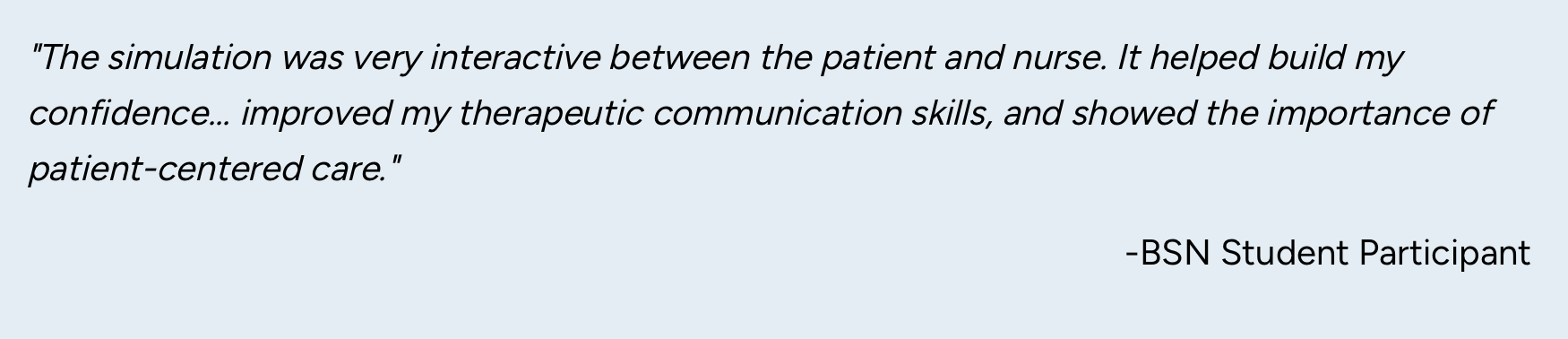
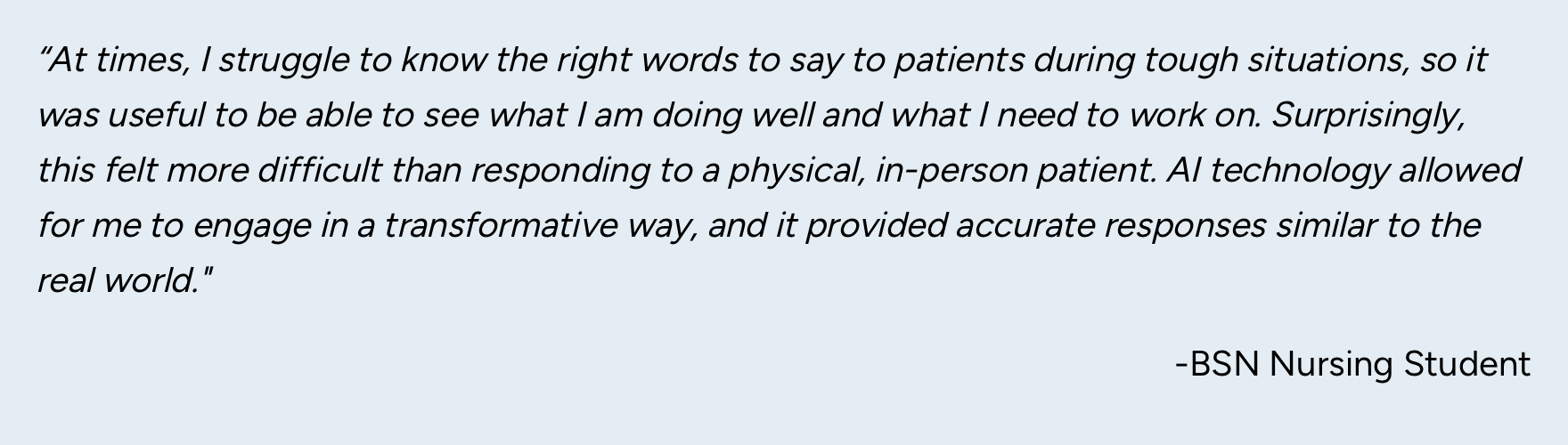
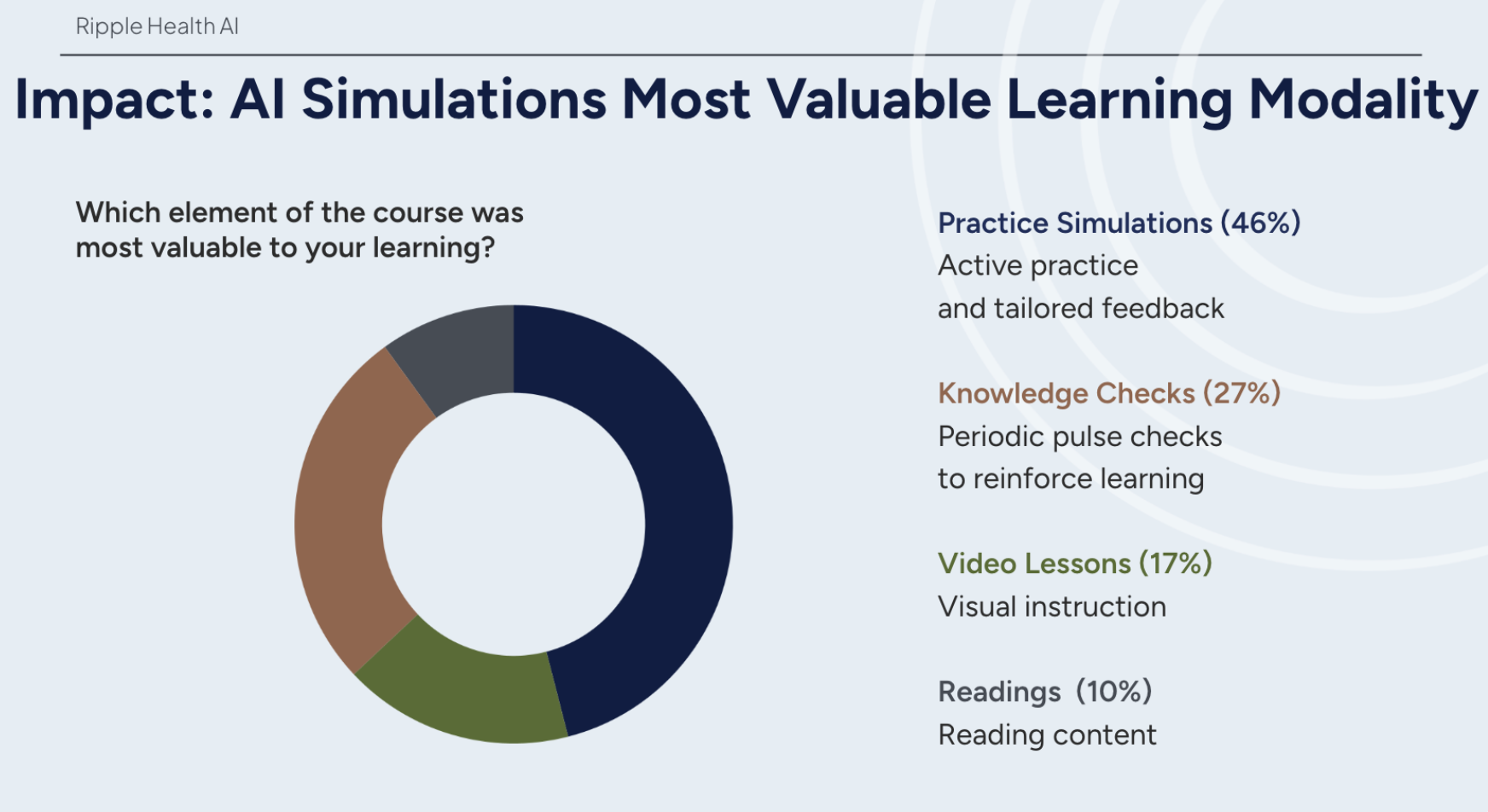
When analyzing what made the curriculum so impactful, the learner verdict was unanimous: the AI-powered practice simulations were the single most valuable element. Students consistently shared that the scenarios felt remarkably authentic, making them feel as though they were interacting with a real, live patient rather than a software interface.

A Four-Pillar Framework for Transforming the Pipeline

1. Undergraduate Nursing Education: Building the Foundation

When nursing students enter clinical rotations, they are often overwhelmed by technical data. However, translating a clinical spike in blood pressure into a clear, actionable directive to a busy physician requires a completely different cognitive skill set.

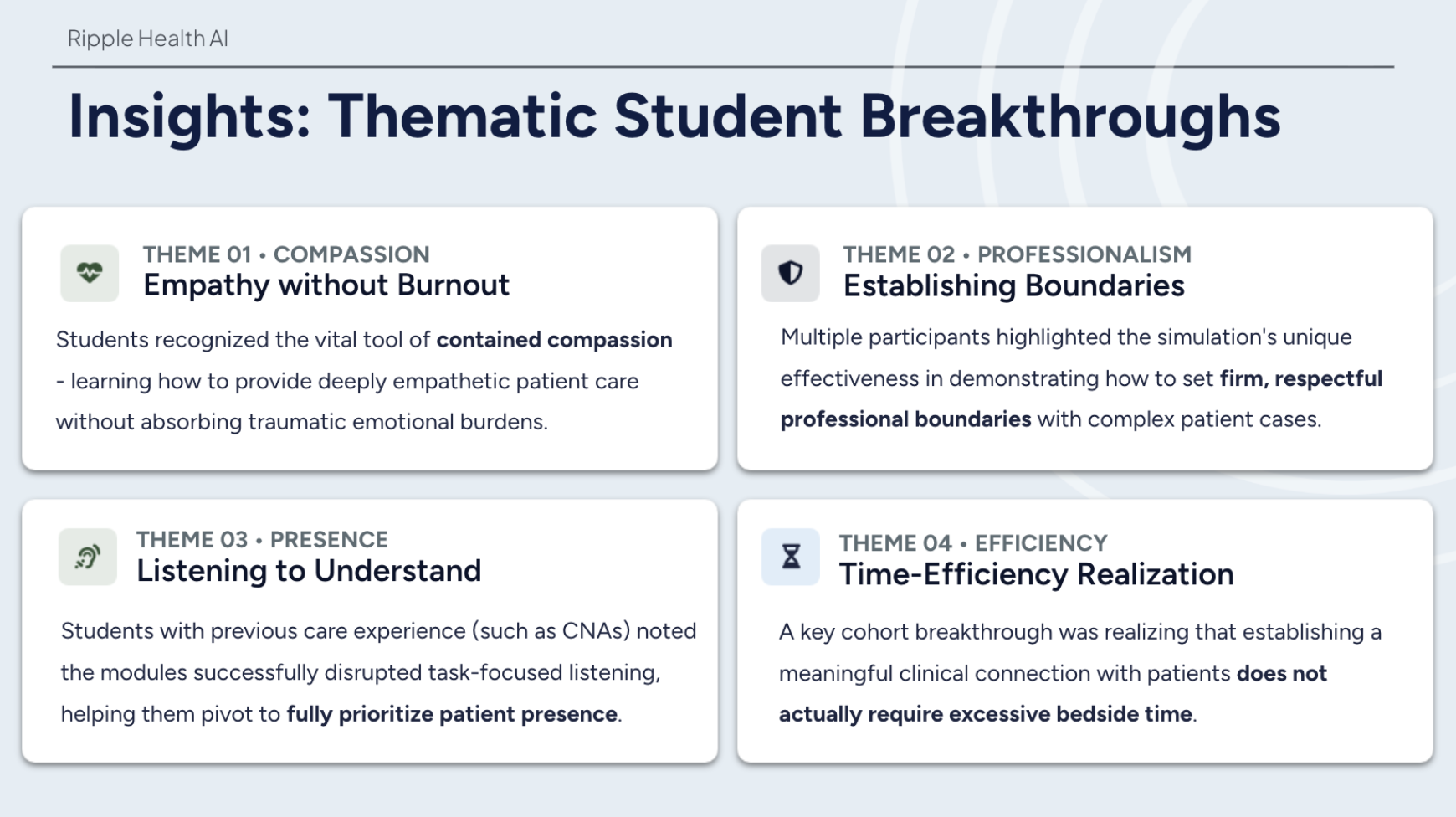
Structured communication training acts as an architectural blueprint for high-stress dialogue. Experiential student feedback from the pilot confirmed that practicing in these safe, AI-simulated environments directly targets this gap, leaving students with an immediate boost in therapeutic communication skills and a deeper appreciation for patient-centered care. When students learn how to navigate realistic scenarios early on, they enter our hospitals equipped to cut through clinical noise - mitigating preventable medical errors before they ever reach the bedside.

2. New Graduate Nurse Training: Bridging the Transition into Practice

The transition from student to novice nurse is notoriously jarring. While undergraduate education sets the baseline, the high-stakes reality of independent practice demands targeted, ongoing communication training during the transition to practice (TTP) or nurse residency phase.

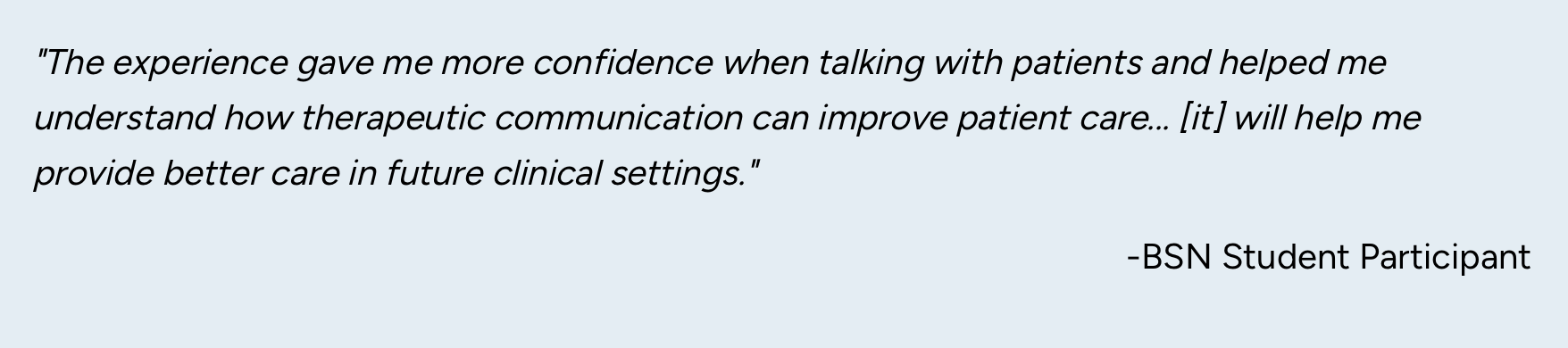
New graduates regularly cite multidisciplinary conflict and a lack of psychological safety as primary drivers for leaving the profession within their first two years. Immersive training bridges this divide by directly fostering professional confidence. As students noted in the pilot, interactive practice helped them understand the direct line between therapeutic dialogue and safer clinical outcomes. Teaching new graduates to navigate workplace friction, manage difficult patient interactions, and advocate assertively for safety under real-world pressures dramatically reduces role confusion and stabilizes early-career job satisfaction.

3. Elevating the Patient Experience

Patient satisfaction is intimately tied to how care is delivered across all stages of a nurse's career. Research indicates that patients and caregivers evaluate a nurse's empathy, active listening, and presence just as heavily as their technical competence.

Formal communication interventions help both students and new graduates cultivate emotional intelligence and rapport. Participants in the training remarked that the realistic nature of the AI simulations gave them a clearer vision of how to provide better, more empathetic care in their future clinical placements. By maintaining this training standard through their first year of practice, we accelerate nurse-patient trust, directly improving post-discharge compliance, care quality, and patient satisfaction scores.

4. The Faculty and Mentor Imperative: Leveraging Technology for Success

We cannot expect students or new graduates to master complex professional dialogue if their instructors and clinical preceptors are not explicitly equipped to teach it. Communication training is highly nuanced and requires dedicated institutional support.

Shifting from traditional lecturing or passive monitoring to advanced simulation requires the right tools. Educators and preceptors must leverage specialized technology to complement training, fostering psychological safety, evidence-based feedback, and supportive, zero-risk environments where learners can safely fail, iterate, and grow without the pressure of live clinical stakes.

The Strategic Next Step for Leaders

We can no longer afford to treat communication as an innate trait that clinicians will simply "pick up" on the floor. It is a highly technical, trainable competency that must be built in school, reinforced during onboarding, and evaluated regularly.

Ripple Health AI offers personalized, AI-driven learning experiences that deliver individualized, actionable feedback in real-time. Our scalable technology solutions tailor directly to your institutional specifications, aligning clinical expertise with essential interpersonal skills to ensure the next generation of your nursing workforce is both confident and competent.

As healthcare and academic leaders, investing in robust communication simulation is our clearest path forward. By securing the communicative readiness of our students and new graduates today, we ensure safer clinical outcomes, stronger team retention, and a higher standard of care for tomorrow.

Request a Ripple Health AI Demo

References

  • Arrogante, O., Ortuño-Soriano, I., & Fernandes-Ribeiro, A. (2025). Attitudinal shifts toward communication skill development in first-year nursing cohorts via high-fidelity simulation: A quasi-experimental analysis. Clinical Simulation in Nursing, 101.

  • Cho, H. and Steege, L.M. (2025). Authentic Leadership, Psychological Safety, Missed Nursing Care, and Intention to Leave Among Hospital Nurses. Int Nurs Rev, 72: e70065. https://doi.org/10.1111/inr.70065

  • Lyu, XC., Huang, SS., Ye, XM. et al. (2024). What influences newly graduated registered nurses’ intention to leave the nursing profession? An integrative review. BMC Nurs 23, 57. https://doi.org/10.1186/s12912-023-01685-z

  • Mercan, N., Coskun, S., & Apaydın Demirci, Z. (2023). Efficacy of a communication skills training for nursing students: a quasi-experimental study. J Psy Nurs, 14(3), 200-209. https://doi.org/10.14744/phd.2023.02438.

  • The Joint Commission. (2025). Sentinel Event Data 2024 Annual Review. https://digitalassets.jointcommission.org/api/public/content/eac7511986c0442a9c1ae04b1aa02cc0?v=ad34daa0


About the Author: Sarah K. Wells, MSN, RN, CEN, CNL is an experienced nurse career strategist dedicated to helping nurses and nurse practitioners of all experience levels and specialties achieve success in their nursing and NP journeys. Sarah founded New Thing Nurse and NTN Consults to help provide support and guidance to the nursing and healthcare community in a simple and direct format. Sarah’s vision is to foster a more supportive and fulfilled nursing world that spreads throughout healthcare and beyond.

Sarah has partnered with Ripple Health AI as a Nurse Advisor and Business Development Lead. The original version of this article appeared on the Ripple Health AI Insights blog.

Sarah is serving as a 2026 Advocacy Fellow with ANA-California, focusing on AI and equitable nurse staffing. Learn more about the 2026 ANA-California Advocacy Fellowships.


New Thing Nurse helps the nursing and NP community thrive in their careers! Join us on IG or Facebook @newthingnurse 🩺

June 18, 2026 /Sarah Wells
2026, LINKEDIN, SOCIAL MEDIA, PROFESSIONAL, NETWORKING, NEW THING NURSE, RESUME, JOB APPLICATIONS, NEW JOB, ATS, NURSE, NURSING, NURSING STUDENT, NURSE TRIBE, NURSE MOM, NURSE LEADER, NURSE CONSULTANT, NURSEING, RN, REGISTERED NURSE, STUDENT NURSE, NURSING SCHOOL, FUTURE NURSE, RNS, NURSING STUDENTS, NURSINGSCHOOL, NURSINGSTUDENT, JOB, FIRST JOB, JOBS, NURS JOB, NURSE JOB, JOB OPPORTUNITIES, JOB SKILLS, RESUME WRITING, SKILSS, HOW TO, MYTHS, TRUTH, TRAVEL, TRAVELING, TRAVEL NURSE, TRAVEL NURSING, ICU, ER, ED, ED NURSE, ER NURSE, ICU NURSE, PCU, MEDICAL SURGICAL, TELEMETRY, HOSPITAL, HOSPITAL JOB, HOSPITAL LIFE, STUDENT NURSE LIFE, MEDICAL, MEDICINE, HEALTHCARE, HEALTH, DIY, DO IT YOURSELF, JOB SEARCH, NURSE LIFE, NURSE STRONG, NURSE LOVE, LOVE, SUCCESS, SUCCESSFUL, SUCCEED, CLIENTS, CLINIC, CLINICS, COVER LETTER, INTERVIEW, INTERVIEWS, INTERVIEW ADVICE, ADVICE, INTERVIEW COACHING, INTERVIEW COACH, INTERVIEWER, JOB INTERVIEWS, JOB INTERVIEW, PAY, COMPENSATION, PAYCHECK, PAY CHECK, JOB ADVICE, NEGOTIATIONS, WAGES, WAGE, PRECEPTOR, PRECEPTORSHIP, NEW GRAD NURSE, NURSINGSTUDENTLIFE, ORIENTATION, INTENTIONS, NEW YEAR, GOALS, ADVOCACY, AI, ARTIFICIAL INTELLIGENCE, WORKFORCE BUILDING, STAFFING, NURSE STAFFING, HIRING, SCHEDULING, NEW GRAD, communication, transformation
1 Comment

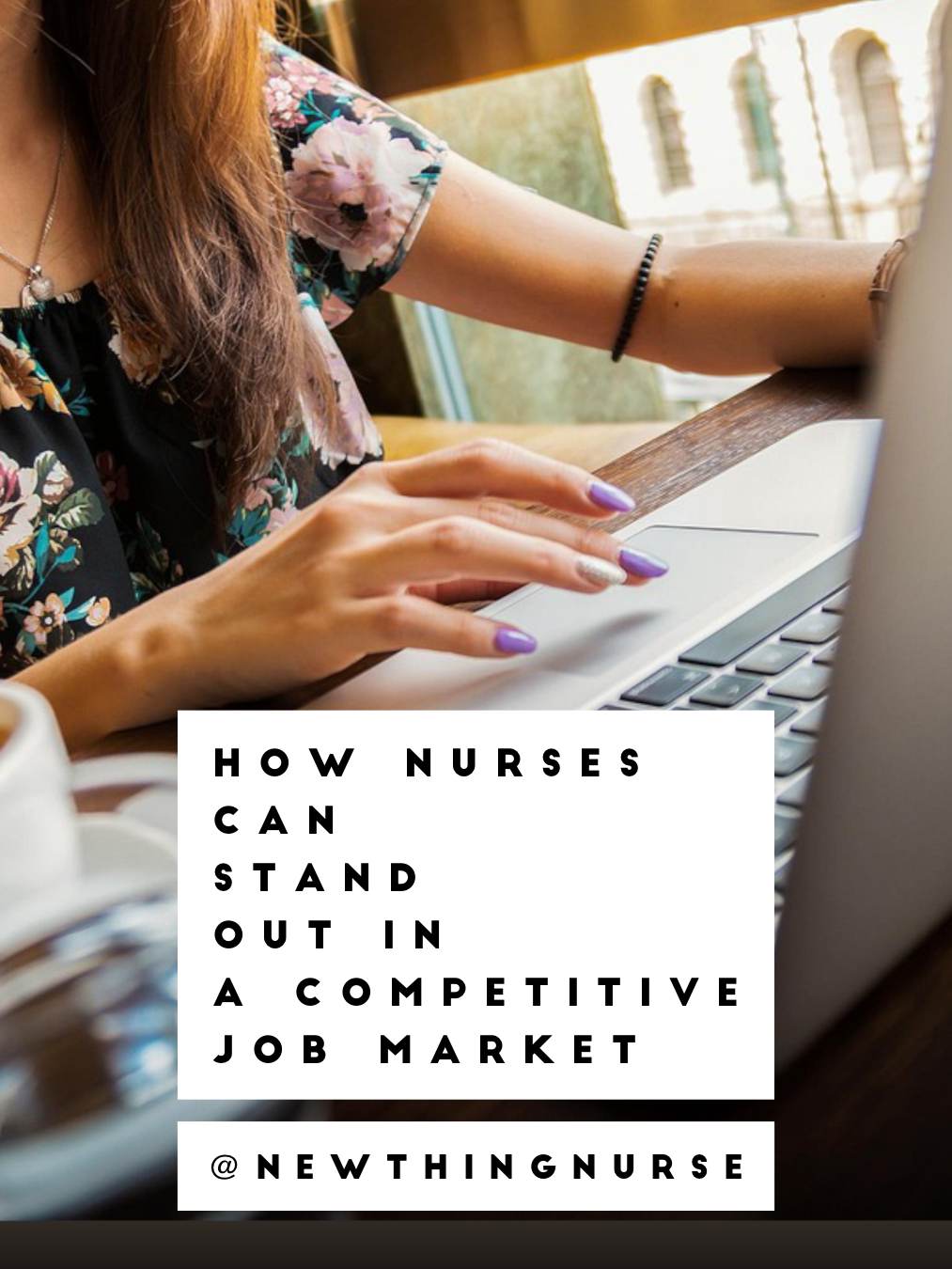
How Nurses Can Stand Out in a Competitive Job Market

May 30, 2026 by Sarah Wells

By: Sarah K. Wells MSN RN CEN CNL

Today’s nursing job market can feel shockingly competitive. While healthcare organizations continue to face staffing challenges, many employers are also receiving large volumes of applications for desirable positions. To manage this influx, organizations increasingly rely on applicant tracking systems (ATS) and artificial intelligence (AI)-enabled software to screen candidates before a human recruiter ever reviews an application.

For nurses, this means that having the right qualifications is only part of the equation. It’s equally important to ensure your application clearly communicates your value in a way that both technology and hiring managers can recognize.

Resumes are KEY

Start by carefully reviewing the job description and incorporating relevant keywords throughout your resume and cover letter. If a position emphasizes patient education, triage, leadership, quality improvement, or electronic health record experience, be sure to include those exact terms when they accurately reflect your experience. ATS software often prioritizes applications that closely align with the language used in the posting.

Next, focus on measurable accomplishments rather than simply listing responsibilities. Instead of stating that you “provided patient care,” highlight outcomes such as improving patient leading a practice change initiative, preempting or mentoring new staff, or participating in committees, councils, and quality improvement projects.

Networking = The Secret Sauce

Networking remains one of the most powerful tools in any job search. Connect with colleagues, attend professional conferences, engage with nursing organizations, and maintain an active LinkedIn presence. Personal connections can help your application get pulled from a sea of digital submissions.

Stand out from the crowd!

Technology may influence the hiring process, but authentic experience, strong professional relationships, and a well-crafted applications remain the keys to standing out as a nursing candidate.


Need help with your resume?

Check out the New Thing Nurse Winning Nurse Resume + Cover Letter Template Series


About the Author: Sarah K. Wells, MSN, RN, CEN, CNL is an experienced nurse career strategist dedicated to helping nurses and nurse practitioners of all experience levels and specialties achieve success in their nursing and NP journeys. Sarah founded New Thing Nurse and NTN Consults to help provide support and guidance to the nursing and healthcare community in a simple and direct format. Sarah’s vision is to foster a more supportive and fulfilled nursing world that spreads throughout healthcare and beyond.

Sarah is serving as a 2026 Advocacy Fellow with ANA-California, focusing on AI and equitable nurse staffing. Learn more about the 2026 ANA-California Advocacy Fellowships.


New Thing Nurse helps the nursing and NP community thrive in their careers! Join us on IG or Facebook @newthingnurse 🩺
May 30, 2026 /Sarah Wells
2026, LINKEDIN, SOCIAL MEDIA, PROFESSIONAL, NETWORKING, NEW THING NURSE, RESUME, JOB APPLICATIONS, NEW JOB, ATS, NURSE, NURSING, NURSING STUDENT, NURSE TRIBE, NURSE MOM, NURSE LEADER, NURSE CONSULTANT, NURSEING, RN, REGISTERED NURSE, STUDENT NURSE, NURSING SCHOOL, FUTURE NURSE, RNS, NURSING STUDENTS, NURSINGSCHOOL, NURSINGSTUDENT, JOB, FIRST JOB, JOBS, NURS JOB, NURSE JOB, JOB OPPORTUNITIES, JOB SKILLS, RESUME WRITING, SKILSS, HOW TO, MYTHS, TRUTH, TRAVEL, TRAVELING, TRAVEL NURSE, TRAVEL NURSING, ICU, ER, ED, ED NURSE, ER NURSE, ICU NURSE, PCU, MEDICAL SURGICAL, TELEMETRY, HOSPITAL, HOSPITAL JOB, HOSPITAL LIFE, STUDENT NURSE LIFE, MEDICAL, MEDICINE, HEALTHCARE, HEALTH, DIY, DO IT YOURSELF, JOB SEARCH, NURSE LIFE, NURSE STRONG, NURSE LOVE, LOVE, SUCCESS, SUCCESSFUL, SUCCEED, CLIENTS, CLINIC, CLINICS, COVER LETTER, INTERVIEW, INTERVIEWS, INTERVIEW ADVICE, ADVICE, INTERVIEW COACHING, INTERVIEW COACH, INTERVIEWER, JOB INTERVIEWS, JOB INTERVIEW, PAY, COMPENSATION, PAYCHECK, PAY CHECK, JOB ADVICE, NEGOTIATIONS, WAGES, WAGE, PRECEPTOR, PRECEPTORSHIP, NEW GRAD NURSE, NURSINGSTUDENTLIFE, ORIENTATION, INTENTIONS, NEW YEAR, GOALS, ADVOCACY, AI, ARTIFICIAL INTELLIGENCE, WORKFORCE BUILDING, STAFFING, NURSE STAFFING, HIRING, SCHEDULING, NEW GRAD, artificial intelligence, networking
Comment

Why New Graduate Nurses Are Struggling to Find Jobs in 2026

May 13, 2026 by Sarah Wells

By: Sarah K. Wells MSN RN CEN CNL

For years, nursing students were told that graduation would practically guarantee a job offer. While nursing staffing shortages still exist across the United States, many new graduate nurses in 2026 are discovering that landing a first nursing role is far more complicated than expected.

The stories are all over social.

I am a member of many new graduate nursing groups on social media. Every day, you can see dozens of posts by members expressing emotions ranging from frustration and anger to desperation and defeat while explaining their experiences applying to dozens to hundreds of job applications, sometimes without receiving an invitation for a single interview.

These posts are by new graduate nurses who are months, and sometimes a year or more, out from graduation. They have passed their NCLEX, have a license, and are fully qualified to start their nursing careers, yet they have received only rejection or worse, no response at all from potential employers as to why they are not interested in hiring them.

The Barriers

One major challenge is the growing mismatch between staffing needs and hiring preferences. Hospitals continue to report workforce shortages, but many organizations are prioritizing experienced nurses who require less onboarding and orientation support. Extended nurse residency programs, limited preceptor availability, and budget limitations have made some employers more selective when hiring brand-new graduates.

At the same time, competition has increased significantly in desirable specialties and locations. Acute care specialties like emergency departments, labor and delivery units, pediatrics, critical care, and large urban hospitals in preferred metro areas often receive hundreds to thousands of applications for only a handful of new graduate spots.

Many applicants are also competing against internal candidates such as new graduate nurses who have worked as nursing assistants, externs, or student workers and already have relationships and seniority within the organization.

Further, technology is creating additional barriers. Many healthcare systems now rely on applicant tracking system (ATS) software and AI-assisted screening tools to filter resumes before a recruiter ever lays eyes on them. Qualified candidates may be overlooked if their resumes are poorly formatted, missing keywords from the job description, or not optimized for automated systems.

Read that again.

Qualified new graduate nurses are not considered for jobs because their resume is not formatted to be compatible with ATS and AI-assisted screening tools.

Finally, new graduates are entering a healthcare environment shaped by ongoing burnout from unhealthy and unsafe workplaces, increasing financial concerns, and operational instability. Some hospitals have reduced hiring volumes or enacted complete hiring freezes, delayed residency cohorts, or shifted resources toward retaining current staff instead of expanding onboarding programs.

It is not you. It is the system.

Despite these challenges, new graduate nurses should not interpret a difficult job search as a reflection of their value or future potential.

It is not you.

It is a systems problem.

It is critical to take care of your mental health during this process. Constant rejection can feel personal when it’s not. Remember to care for yourself as you continue your job search journey.

Strategies for Success

There are strategies that support new graduate nurses in landing their first job:

  • Strategic networking

  • Flexible job searching

  • Resumes optimized for HR tech tools

  • Professional social media

  • Persistence

For many nurses, the first opportunity may not look exactly as expected, but it can still become the foundation for a long and successful nursing career.


Are you a new grad nurse applying for your first job?

Explore the products and services from New Thing Nurse


About the Author: Sarah K. Wells, MSN, RN, CEN, CNL is an experienced nurse career strategist dedicated to helping nurses and nurse practitioners of all experience levels and specialties achieve success in their nursing and NP journeys. Sarah founded New Thing Nurse and NTN Consults to help provide support and guidance to the nursing and healthcare community in a simple and direct format. Sarah’s vision is to foster a more supportive and fulfilled nursing world that spreads throughout healthcare and beyond.

Sarah is serving as a 2026 Advocacy Fellow with ANA-California, focusing on AI and equitable nurse staffing. Learn more about the 2026 ANA-California Advocacy Fellowships.


New Thing Nurse helps the nursing and NP community thrive in their careers! Join us on IG or Facebook @newthingnurse 🩺
May 13, 2026 /Sarah Wells
2026, LINKEDIN, SOCIAL MEDIA, PROFESSIONAL, NETWORKING, NEW THING NURSE, RESUME, JOB APPLICATIONS, NEW JOB, ATS, NURSE, NURSING, NURSING STUDENT, NURSE TRIBE, NURSE MOM, NURSE LEADER, NURSE CONSULTANT, NURSEING, RN, REGISTERED NURSE, STUDENT NURSE, NURSING SCHOOL, FUTURE NURSE, RNS, NURSING STUDENTS, NURSINGSCHOOL, NURSINGSTUDENT, JOB, FIRST JOB, JOBS, NURS JOB, NURSE JOB, JOB OPPORTUNITIES, JOB SKILLS, RESUME WRITING, SKILSS, HOW TO, MYTHS, TRUTH, TRAVEL, TRAVELING, TRAVEL NURSE, TRAVEL NURSING, ICU, ER, ED, ED NURSE, ER NURSE, ICU NURSE, PCU, MEDICAL SURGICAL, TELEMETRY, HOSPITAL, HOSPITAL JOB, HOSPITAL LIFE, STUDENT NURSE LIFE, MEDICAL, MEDICINE, HEALTHCARE, HEALTH, DIY, DO IT YOURSELF, JOB SEARCH, NURSE LIFE, NURSE STRONG, NURSE LOVE, LOVE, SUCCESS, SUCCESSFUL, SUCCEED, CLIENTS, CLINIC, CLINICS, COVER LETTER, INTERVIEW, INTERVIEWS, INTERVIEW ADVICE, ADVICE, INTERVIEW COACHING, INTERVIEW COACH, INTERVIEWER, JOB INTERVIEWS, JOB INTERVIEW, PAY, COMPENSATION, PAYCHECK, PAY CHECK, JOB ADVICE, NEGOTIATIONS, WAGES, WAGE, PRECEPTOR, PRECEPTORSHIP, NEW GRAD NURSE, NURSINGSTUDENTLIFE, ORIENTATION, INTENTIONS, NEW YEAR, GOALS, ADVOCACY, AI, ARTIFICIAL INTELLIGENCE, WORKFORCE BUILDING, STAFFING, NURSE STAFFING, HIRING, SCHEDULING, new grad nurse, new grad, future nurse, nursing student, nursing students, nursing school

You Matter: The Worth of an Emergency Nurse

May 08, 2026 by Sarah Wells

By: Kristen Cline BSN RN CEN CPEN TCRN CFRN CTRN CCRN

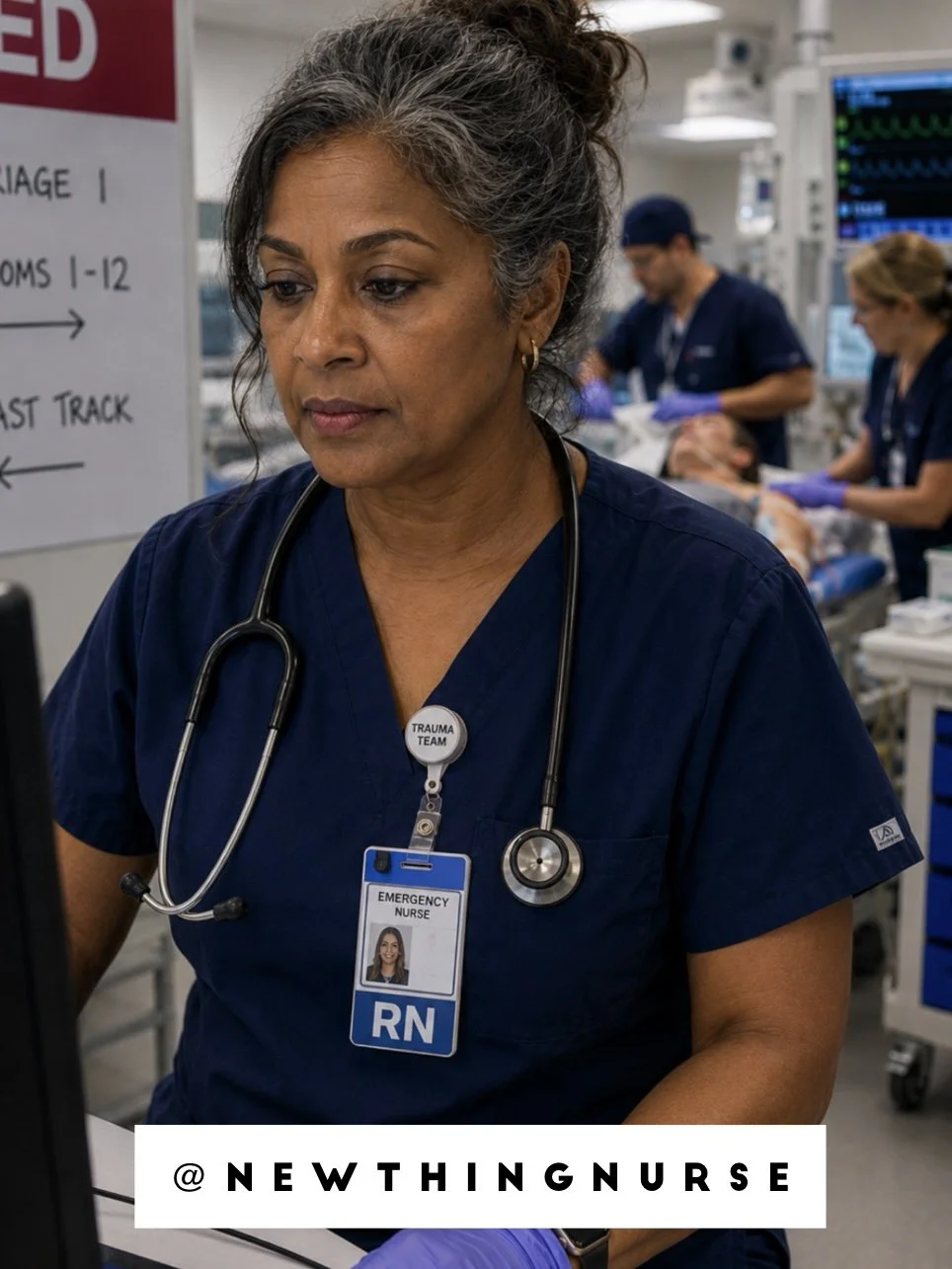
I see her in a corner of the Emergency Department. A small figure in scrubs that are too big, with wiry white hair that rejects a brush. She is a fixture in this community hospital, and she is checking the crash cart. She has outlasted her peers and has never worked anywhere else. She teaches full time: ACLS, PALS, NIHSS, all the letters. Her voice is low, but her eyes are sharp.

Those eyes meet mine across the busy ED. I can't stop to talk: I have two new graduate nurse residents with me. One fresh and young, full of confidence and promise who fell in love with the ED when he saw his first open thoracotomy during clinicals.

This is where I want to be.

The other, a nontraditional nursing student who spent much of her adult life in the Pre-Op unit as a CNA. She is a mom who fought for her BSN while raising two children. She knows everyone in the hospital, asks a million questions, and radiates intensity.

This is where I want to be.

I spent almost seventeen years in clinical practice as an ED charge nurse, an ICU nurse, and a flight nurse. Now that I am a clinical educator. Nurses are my patients. These two new nurses are a life-giving source of energy and hope that the whole unit can sense, fresh clean air blowing away the cobwebs. I want them to love their chosen profession, and I arm them as best I can against what’s coming: the understaffing and the moral injury, the violence and the administrative indifference, the slow erosion of conditions forcing good nurses to leave. They remind me that we can be better. We must be.

The seasoned nurse smiles. Maybe she sees in me what I see in my nurse residents. Maybe she sees the crowd of nurses she has trained over the many decades whose names she has forgotten, but who will never forget her. Does she perceive the magnitude of her life? How do we put a value on a lifetime of service? When she looks back at her long career, what does she see? Does she understand the impact she has made?

How does she know she mattered?

You matter: The Worth of an Emergency Nurse

What is the worth of a nurse? One could consider many metrics: some nurses consider the cost of their degree both in time and trials, if not merely the price of their student loans. Society has quantified the lack of nurses and called it a “nursing shortage”. A CFO’s spreadsheet might see nursing as a cost center, FTEs to optimize and eliminate.

What does a single nurse, over a 30-year span of service, contribute to the economy in objective metrics? The cumulative impact of a single bedside nurse across an entire career is scattered through a constellation of published studies. Assembled, it tells a story the spreadsheets have been missing.

The Emergency Nurse: 100,000 Patient Lives Changed

Consider an emergency nurse. Three twelve-hour shifts a week in a mid-volume ED that sees 60,000 visits a year. On a busy shift, they may treat 20 patients or more. On a quiet one, merely 12. They triage and stabilize, teach and advocate. They hold the hand of the trauma patient whose family has not arrived. They bring another back to life with muscle and will. They offer dignity with a shower and a meal to the one with nowhere else to go. 156 shifts a year. Plus overtime. An endless sea of faces who each remember the nurse who got them through the worst day of their lives, even if the name is misremembered.

Over 30 years, that nurse will care for an estimated 100,000 patients. One hundred thousand human beings touched by those hands. Some were dying. Many were afraid. Roughly 12% of them — 12,000 people — arrived with life-threatening or emergent conditions. Some of them were clinically bereft of life. The emergency nurse will participate in an estimated 500 to 1,000 cardiac resuscitations across a career.†

Not every code is a save, and not every save is during a code. Most are quieter than that. The chest pain patient in bed 4 looks gray and diaphoretic: the ED nurse gets a 12-lead before the physician has finished triage. ST elevation in II, III, aVF, an inferior STEMI. The cath lab is activated before the patient fully understands what is happening, but the nurse will talk them through. The nurse who spots the tombstones and makes that call has just bought precious more minutes of life.

Strokes are even faster. During an untreated ischemic stroke, the brain loses 1.9 million neurons every minute starved of oxygen. The ED nurse performs the stroke scale at the bedside, activates the stroke alert, and initiates the chain that gets TNK to the patient before the window closes. Neurons, counted in millions and costing days, saved or lost by the speed of the nurse's hands.

Before any of this happens, every ED visit begins with two minutes at the front door. A nurse looks at you, takes your vitals, asks why you came. They are deciding how sick you are in the time it takes most clinicians to wash their hands. Triage is the highest-stakes two-minute decision in healthcare, made thousands of times a year.

Then there is sepsis. The patient who often looks sick in a way that doesn't match their vitals yet. Tachycardic but not hypotensive. Warm but wrong. Pink and panting. The ED nurse draws the lactate, obtains cultures, gives fluids and pushes the first antibiotic while the workup is still running.

Sepsis is the third leading cause of in-hospital death.  Over 30 years, one ED nurse will screen roughly 21,000 patients for serious infection and manage 800 to 3,000 confirmed sepsis cases, each one a race the patient doesn't know they might lose.

More than one in ten American deaths occurs in an emergency department. Over a 30-year career, one ED nurse will be present for roughly 210 of those deaths — about seven a year, one every seven or eight weeks. Some arrive in arrest with life long passed. Some die despite our very best. A few die in ways that stay with us for years, surfacing without warning in the shower or on the drive home.

When death wins, the ED nurse will clean up your loved one. They will change the sheets and put a fresh gown on their still form. They place warm blankets over things no one else should see. They leave a hand out above the sheets, to be held in grief. They turn the lights down low and arrange some chairs, providing coffee and crackers for your family. Someone might be hungry and the cafeteria closed long ago.

Then they call the mortuary, making the arrangements no one can yet bring themselves to contemplate. They give you a few more minutes with your loved one. It’s ok. We don’t need the room for a bit. They give you a few more minutes to pretend this is a bad dream. Once you leave, it becomes terrible and real and now life has an ‘after’.

We let you stay as long as we can.

What is that worth? A 2024 study showed that adding one additional nurse to the busiest ED day shift can shorten stays and avoid $160,000 in lost patient wages per 10,000 visits. That decrease in service times frees up capacity for treating more patients, which may can generate $470,000 in extra net revenues for the facility per 10,000 visits. The authors wrote “investing in nursing will more than pay for itself.

Unintentional injury is the leading cause of death for Americans aged 1 through 44, and the third leading cause of death overall. The 2019 economic cost of injury in the United States reached $4.2 trillion, more than half of which fell on working-age adults. Trauma is unique among acute presentations because the physiology is time-dependent in a way nothing else is. The trauma nurse holds the clock at the bedside from arrival through ICU handoff. Every minute they keep is a minute the patient remains salvageable.

That conversion is mechanical. The trauma activation alert pulls the nurse to the bay before the patient arrives. The primary survey runs in parallel with vascular access, large-bore lines, rapid infuser primed, blood at the bedside before it's needed. The nurse expertly executes the massive transfusion protocol when the surgeon calls for it, and increasingly recognizes the indication before the surgeon makes the call. Pooled data show MTP activation reduces overall trauma mortality by approximately 29%. Each minute of delay between ED arrival and operative bleeding control increases hemorrhagic-death odds by 1.8%. Across 79,000 patients in 34 ACS-verified trauma centers, VTE prophylaxis initiated within 24 hours of admission cut venous thromboembolism by more than half compared to delays beyond 48 hours. Each finding maps to a specific bedside action. Each carries a price in lives.

Pediatrics are particularly vulnerable. A national cohort study of 796,937 children treated in 983 emergency departments demonstrated that high pediatric readiness, which includes metrics such as staffing, equipment, policies, quality improvement, cut in-hospital mortality by 60% to 76%, with the benefit persisting at one year. The investigators modeled that if every ED reached the highest-quartile readiness, approximately 1,442 pediatric deaths could be averted annually. A 2024 follow-up across 417 US trauma centers found that changes in pediatric readiness from 2013 to 2021 mapped directly to changes in pediatric mortality: high-readiness EDs corresponded to 643 lives saved, while persistent low readiness corresponded to 729 preventable pediatric deaths. The pediatric emergency care coordinator role, almost always filled by a nurse, is what holds these readiness elements together at the bedside. A national program, the National Pediatric Readiness Project, is being promoted and operationalized by emergency nurses across the country.

Revenue data largely misses the point. The emergency department is America's last remaining social safety net. The Emergency Medical Treatment and Labor Act (EMTALA) requires screening and stabilization of every patient who darkens the door, regardless of ability to pay. The ED nurse performs social work, crisis intervention, intimate partner violence screening, and substance use disorder counseling. None of it appears on a hospital bill, all of which holds together what's left of the social contract.

ED often involve a mental health or substance use crisis, with wait times for boarded patients awaiting transfer to a dedicated mental health facility lasting from hours to days. During those hours, the ED nurse is the psychiatric provider: performing risk assessment, managing agitation, sitting with patients in rooms stripped of anything that could cause harm, checking on them every fifteen minutes through the night.

They do this while facing an epidemic of workplace violence: 70% of ED nurses report being physically assaulted at work, often with no repercussions and no laws to protect them. They do it anyway. They’re often told that it is simply "part of the job."

……………..

I think about the nurse with the white hair checking the crash cart. Thirty years in one emergency department. How many patients passed through her hands — fifty thousand? Eighty thousand? How many new nurses learned to read a rhythm strip because she was patient enough to teach them? How many codes ran smoothly because she had checked that cart, again, the way she always has? Steady, consistent; not glamorous but vital. Life preserving.

You matter.

Note:

† The 500–1,000 career resuscitation estimate is an illustrative calculation: roughly 292,000 adult in-hospital cardiac arrests occur annually, with about 10% in emergency departments, plus transported out-of-hospital arrests, distributed across approximately 5,000 US emergency departments.


About the Author: Kristen Cline is a Professional Development Practitioner in the Bay Areaand the founder of Regulation Loop LLC. Her clinical career spans 20 years across emergency, ICU, and flight nursing, including service as a Trauma Program Manager.  Her published work appears in Annals of Emergency Medicine, the Journal of Emergency Nursing, the Bulletin of the Atomic Scientists, KevinMD and several major nursing textbooks and serves on the editorial board of Air Medical Journal.


Follow Kristen Cline:

Email: kristen.cline@gmail.com

LinkedIn: linkedin.com/in/kristen-m-cline

SubStack: kristencline1033.substack.com


New Thing Nurse helps the nursing and NP community thrive in their careers! Join us on IG or Facebook @newthingnurse 🩺
May 08, 2026 /Sarah Wells
2026, LINKEDIN, SOCIAL MEDIA, PROFESSIONAL, NETWORKING, NEW THING NURSE, RESUME, JOB APPLICATIONS, NEW JOB, ATS, NURSE, NURSING, NURSING STUDENT, NURSE TRIBE, NURSE MOM, NURSE LEADER, NURSE CONSULTANT, NURSEING, RN, REGISTERED NURSE, STUDENT NURSE, NURSING SCHOOL, FUTURE NURSE, RNS, NURSING STUDENTS, NURSINGSCHOOL, NURSINGSTUDENT, JOB, FIRST JOB, JOBS, NURS JOB, NURSE JOB, JOB OPPORTUNITIES, JOB SKILLS, RESUME WRITING, SKILSS, HOW TO, MYTHS, TRUTH, TRAVEL, TRAVELING, TRAVEL NURSE, TRAVEL NURSING, ICU, ER, ED, ED NURSE, ER NURSE, ICU NURSE, PCU, MEDICAL SURGICAL, TELEMETRY, HOSPITAL, HOSPITAL JOB, HOSPITAL LIFE, STUDENT NURSE LIFE, MEDICAL, MEDICINE, HEALTHCARE, HEALTH, DIY, DO IT YOURSELF, JOB SEARCH, NURSE LIFE, NURSE STRONG, NURSE LOVE, LOVE, SUCCESS, SUCCESSFUL, SUCCEED, CLIENTS, CLINIC, CLINICS, COVER LETTER, INTERVIEW, INTERVIEWS, INTERVIEW ADVICE, ADVICE, INTERVIEW COACHING, INTERVIEW COACH, INTERVIEWER, JOB INTERVIEWS, JOB INTERVIEW, PAY, COMPENSATION, PAYCHECK, PAY CHECK, JOB ADVICE, NEGOTIATIONS, WAGES, WAGE, PRECEPTOR, PRECEPTORSHIP, NEW GRAD NURSE, NURSINGSTUDENTLIFE, ORIENTATION, INTENTIONS, NEW YEAR, GOALS, ADVOCACY, AI, ARTIFICIAL INTELLIGENCE, WORKFORCE BUILDING, STAFFING, NURSE STAFFING, HIRING, SCHEDULING, emergency, emergency nurse, nurses week, nurses month
Comment

Powered by Squarespace