New Thing Nurse

Let us help with your new thing.

  • NTN Consults
  • Home
  • About
    • Who is the New Thing Nurse?
    • NEW THING NURSE
    • DISCLAIMERS
  • TEMPLATES
  • Services
    • NURSING STUDENTS & NEW GRADS
    • EXPERIENCED NURSES
    • NURSE PRACTITIONERS
    • WORKSHOPS & EVENTS
    • FAQ: HAVE A QUESTION? READ THIS
    • REVIEWS
  • ADVOCACY
  • BLOG
  • RESOURCES
    • FAVORITES
    • PPE CARE PACKAGE PROJECT
    • MENTAL HEALTH
    • VIOLENCE AGAINST HEALTHCARE WORKERS
  • CONTACT

What Every Nurse Needs to Know About AI

August 27, 2026 by Sarah Wells

By: Sarah K. Wells MSN RN CEN CNL

I write a lot about technology, nursing, and healthcare. For the last year, I have been learning more and more about artificial intelligence (AI) in healthcare. AI has entered the clinical environment fast. As a nurse, here are tips how to work with it confidently and critically.

Healthcare has seen waves of technology come and go: electronic health records (EHR), telehealth, wearable monitors, virtual nursing are just a few examples. AI feels different, and for good reason. Unlike a new charting system or a “smarter” infusion pump, AI doesn't just assist with a task. It increasingly participates in clinical decision-making. In some cases, it can feel like it is making decisions for you. For nurses and other clinicians, that changes everything.

As a nurse in the AI era, you don't need to become a data scientist. But you do need to understand what AI is doing in your workplace, where it can go wrong, and how your professional judgment remains irreplaceable.

AI in Healthcare Is Already Here

Many nurses are already working alongside AI without realizing it.

Common applications include:

Clinical decision support. Algorithms embedded in EHR systems flag deteriorating patients, suggest sepsis alerts, or highlight potential drug interactions. If your hospital uses an early warning score that updates automatically, that's AI (or at least machine learning) at work.

Diagnostic imaging. Radiology and pathology departments increasingly use AI to complete a first-pass scan on images for anomalies, detecting potential fractures, tumors, or diabetic retinopathy, before a physician reviews them.

Predictive analytics. Some systems forecast which patients are at risk of readmission, pressure injuries, or falls, so care teams can intervene earlier. Predictive analytics are also being used in staff scheduling tools.

Administrative automation. AI is being used to transcribe clinical notes, pre-authorize insurance requests, and draft discharge summaries to potentially free up time that might otherwise be spent on paperwork.

What AI Does Well (and What It Doesn't)

AI excels at pattern recognition across enormous datasets. A model trained on millions of chest X-rays can identify subtle findings that a tired radiologist might miss at 2 a.m. In that narrow task, AI can be genuinely impressive.

But AI has real limitations that every nurse should understand:

It reflects the data it was trained on. If the training data underrepresented certain populations, which has historically been a common issue, the model may perform worse for those patients and worse, perpetuate bias that can increase instead of mitigate health inequities. Tools validated on predominantly white, male, or urban populations may not transfer well to your patient population.

It doesn't know what it doesn't know. AI systems can produce confident-looking outputs even when they're operating outside their reliable range. A model will rarely say "I'm not sure.” It will instead give an answer that it will make the user “happy”. AI is programmed to be agreeable, often prioritizing a user’s “happiness” over objective facts. Checking that answer against your clinical assessment is essential.

It can't account for context the way you can. The algorithm doesn't know that this patient is terrified of hospitals, that their family dynamics are complicated, or that they've been pushing through pain because they're worried about being a burden. You do. You are the essential NURSE in the AI loop.

It can hallucinate. AI language tools, used for note drafting or summarization, can generate plausible-sounding but factually incorrect content. Any AI-generated text that enters the clinical record needs human review and validation before it becomes part of the permanent chart.

Your Professional Accountability Doesn't Change

This is perhaps the most important thing to understand: when an AI tool makes a recommendation and you act on it, the professional and legal accountability still rests with you.

As of this writing, it is generally the rule that the clinician and their license take on the liability of any AI output (created thing) that is validated and acted upon. This may change in the future, but when you agree with clinical AI, you are signing off that you agree with it.

If a sepsis alert fires and you dismiss it without assessment or if you follow an AI recommendation that conflicts with your clinical judgment, you own that decision. "The algorithm told me to" is not a defense in a nursing board hearing or in a court of law.

This isn't meant to frighten you. It's meant to frame AI correctly: as a tool that informs your practice, not one that substitutes for it. The same way you wouldn't blindly follow an MD order without understanding it, you shouldn't blindly follow an AI recommendation without evaluating and validating it.

Practical rule: Do not have AI tell you what to do. Listen to its suggestions and then use critical thinking, clinical judgement, and verified resources to validate the guidance before acting on it.

Remember: Ultimately, it is your license that is on the line.

How to Think Critically About AI in Your Workplace

When a new AI tool is introduced to your unit, ask these questions:

  • What was it trained on? Has it been validated on data for patients or use cases like yours?

  • What does it optimize for? Some models optimize for cost reduction, not patient outcomes. Understand the goal and center discussions around patient care first and budget second

  • Who is accountable when it's wrong? Get clarity on your facility's policies before a problem arises. An ounce of prevention is worth a pound of response.

  • What does a false positive or false negative look like? Every screening tool makes errors. Know what they are, how to report them, and what to do when they come up.

  • How was staff trained? A good AI tool with poor implementation is a patient safety risk. Advocate for increased educational and training time to set up your patients, your team, and yourself for success.

You don't need to understand the math behind the model to ask these questions. Asking them is itself an act of clinical leadership.

AI and Nursing: A replacement or tool to leverage?

There is a version of the AI conversation that worries nurses about job replacement. That concern deserves honest engagement, not dismissal.

AI will likely automate parts of nursing work, particularly documentation, scheduling, and routine monitoring tasks. Whether that frees nurses to spend more time at the bedside or becomes a justification to reduce staffing is a policy and employer question, not necessarily a technology question. It will depend on how healthcare organizations choose to deploy the tools and adhere to their budgets.

What AI cannot replicate is the relational core of nursing: therapeutic presence, the ability to read a room, the skill of delivering hard news with compassion, the advocacy that happens when a nurse says "something isn't right with my patient." Those capacities are not pattern recognition on historical data. They are embodied, relational, and fundamentally human.

The nurses who will thrive in an AI-enabled environment are those who understand the tools well enough to use them critically, and who continue to develop the distinctly human competencies that no algorithm will replicate.

Practical Steps You Can Take Now

1. Learn your tools. Ask your nurse educator or informatics team to walk you through any AI-powered features in your EHR or monitoring systems. Understanding what they flag — and what they miss — makes you a safer practitioner.

2. Document your clinical reasoning. As AI tools generate more of the data in patient records, your documented reasoning becomes even more important as evidence that a human assessed the whole picture.

3. Speak up about concerns. If an AI alert seems to be firing inappropriately — either too often or not enough — report it. Your frontline observations are how these tools get improved or discontinued.

4. Engage with your professional and advocacy organizations. Groups like the American Nurses Association are developing position statements and guidelines on AI in nursing. Stay connected to those conversations.

5. Be a thoughtful voice in your unit. Not every colleague will have the same level of comfort or skepticism about AI. Being someone who asks good questions — without dismissing the technology or uncritically embracing it — is a form of leadership.

AI is not the future of nursing and healthcare, it is the present. Understanding it well enough to use it wisely, question it appropriately, and advocate for patients and clinicians in its presence, that is the new professional competency. And it is squarely within the tradition of what nurses have always done: meet the moment, with knowledge and compassion, on behalf of their patients, clinicians, and the community at large.


About the Author: Sarah K. Wells, MSN, RN, CEN, CNL is an experienced nurse career strategist dedicated to helping nurses and nurse practitioners of all experience levels and specialties achieve success in their nursing and NP journeys. Sarah founded New Thing Nurse and NTN Consults to help provide support and guidance to the nursing and healthcare community in a simple and direct format. Sarah’s vision is to foster a more supportive and fulfilled nursing world that spreads throughout healthcare and beyond.

Sarah has partnered with Ripple Health AI as a Nurse Advisor and Business Development Lead. The original version of this article appeared on the Ripple Health AI Insights blog.

Sarah is serving as a 2026 Advocacy Fellow with ANA-California, focusing on AI and equitable nurse staffing. Learn more about the 2026 ANA-California Advocacy Fellowships.


New Thing Nurse helps the nursing and NP community thrive in their careers! Join us on IG or Facebook @newthingnurse 🩺

August 27, 2026 /Sarah Wells
2026, LINKEDIN, SOCIAL MEDIA, PROFESSIONAL, NETWORKING, NEW THING NURSE, RESUME, JOB APPLICATIONS, NEW JOB, ATS, NURSE, NURSING, NURSING STUDENT, NURSE TRIBE, NURSE MOM, NURSE LEADER, NURSE CONSULTANT, NURSEING, RN, REGISTERED NURSE, STUDENT NURSE, NURSING SCHOOL, FUTURE NURSE, RNS, NURSING STUDENTS, NURSINGSCHOOL, NURSINGSTUDENT, JOB, FIRST JOB, JOBS, NURS JOB, NURSE JOB, JOB OPPORTUNITIES, JOB SKILLS, RESUME WRITING, SKILSS, HOW TO, MYTHS, TRUTH, TRAVEL, TRAVELING, TRAVEL NURSE, TRAVEL NURSING, ICU, ER, ED, ED NURSE, ER NURSE, ICU NURSE, PCU, MEDICAL SURGICAL, TELEMETRY, HOSPITAL, HOSPITAL JOB, HOSPITAL LIFE, STUDENT NURSE LIFE, MEDICAL, MEDICINE, HEALTHCARE, HEALTH, DIY, DO IT YOURSELF, JOB SEARCH, NURSE LIFE, NURSE STRONG, NURSE LOVE, LOVE, SUCCESS, SUCCESSFUL, SUCCEED, CLIENTS, CLINIC, CLINICS, COVER LETTER, INTERVIEW, INTERVIEWS, INTERVIEW ADVICE, ADVICE, INTERVIEW COACHING, INTERVIEW COACH, INTERVIEWER, JOB INTERVIEWS, JOB INTERVIEW, PAY, COMPENSATION, PAYCHECK, PAY CHECK, JOB ADVICE, NEGOTIATIONS, WAGES, WAGE, PRECEPTOR, PRECEPTORSHIP, NEW GRAD NURSE, NURSINGSTUDENTLIFE, ORIENTATION, INTENTIONS, NEW YEAR, GOALS, ADVOCACY, AI, ARTIFICIAL INTELLIGENCE, WORKFORCE BUILDING, STAFFING, NURSE STAFFING, HIRING, SCHEDULING, NEW GRAD, COMMUNICATION, TRANSFORMATION, ai, artificial intelligence
Comment

Closing the Communication Gap in Nursing

June 18, 2026 by Sarah Wells

By: Sarah K. Wells MSN RN CEN CNL

Discover how AI-powered nurse communication training bridges the gap between school and the bedside to reduce medical errors and improve patient satisfaction.

When a breakdown in care occurs, it is rarely due to a lack of clinical knowledge. The Joint Commission Sentinel Event Data Annual Review consistently highlights that hospital adverse events - including falls, treatment delays, and wrong-site surgeries - are overwhelmingly rooted in communication failures during handovers, care transitions, and acute emergencies.

To protect our patients and stabilize our workforce, we must fundamentally reshape how we build and sustain clinical communication. High-fidelity communication training is no longer a "soft skill" luxury; it is a clinical, financial, and educational imperative. To be effective, this training must span the entire developmental continuum: from undergraduate nursing education to formal residency programs for new graduates.

The Ripple Effect

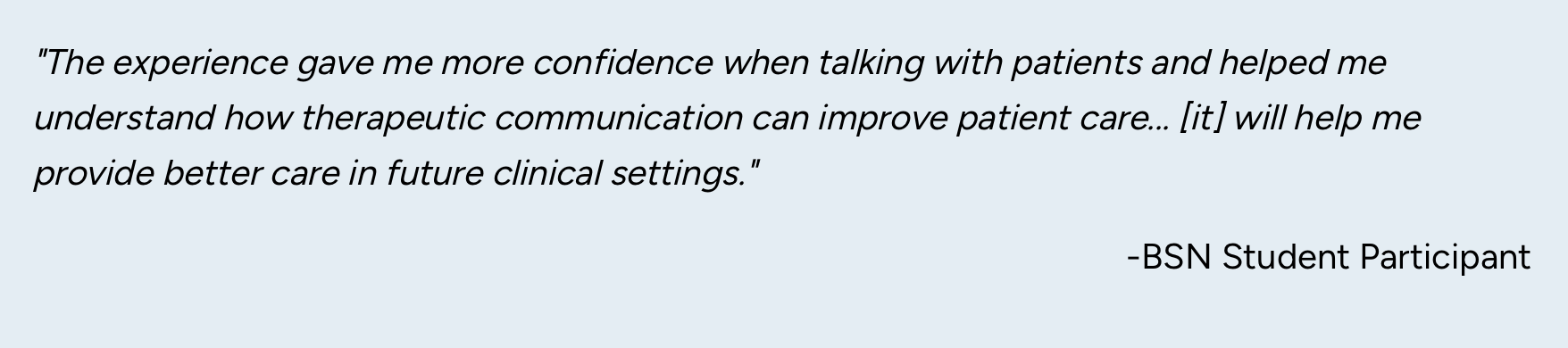
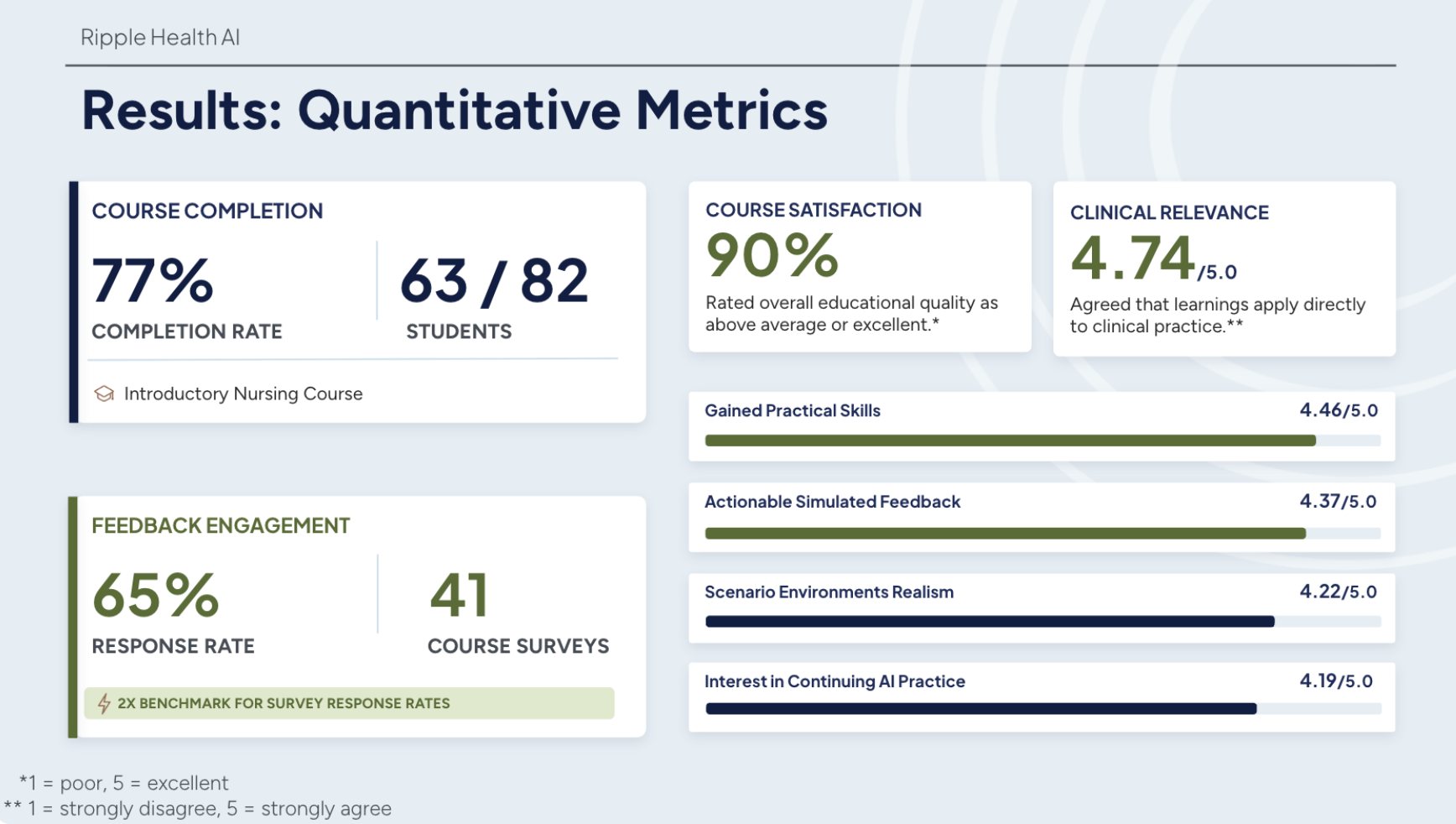
To bridge these academic and clinical gaps, Ripple Health AI delivers tailored solutions designed to support, scale, and standardize this vital work. Recent feedback highlights the tangible, positive practice perceptions experienced by nursing students using our advanced, interactive communication training tools.

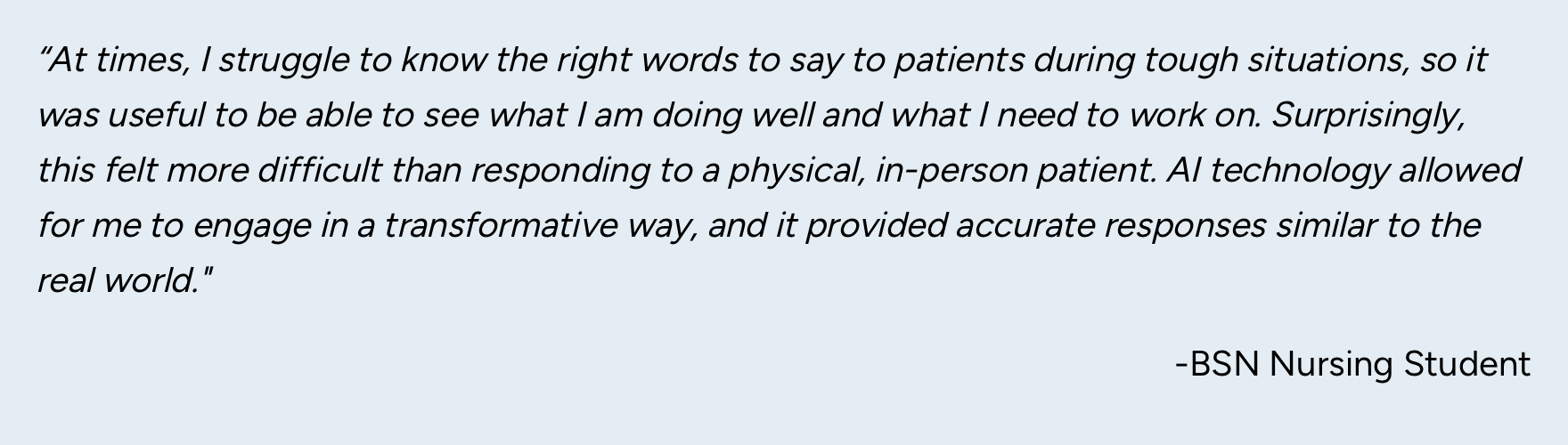
In May 2026, pre-licensure students in a Bachelor of Science in Nursing (BSN) program at a top-tier university on the West Coast utilized the Ripple Health AI platform. Students completed the specialized course, “Communicating with Patients: The 4 C's of Relational Care for Nurses,” sharing detailed insights on how the training shifted their outlook on clinical readiness.

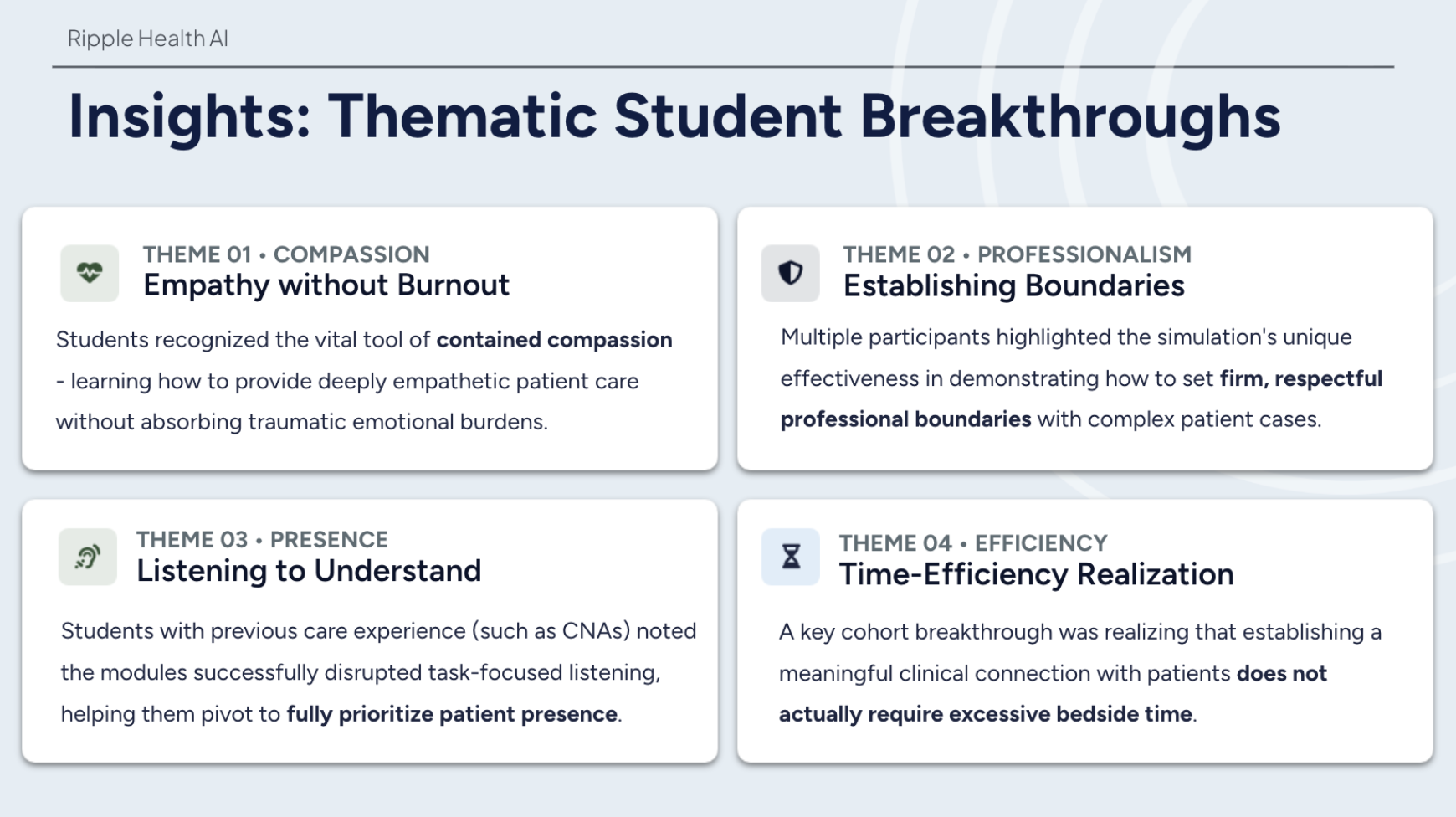
The evaluation underscored remarkable efficacy across key learning domains, with students heavily praising the course's deep relevance to clinical practice and the overall quality of the curriculum. Furthermore, learners highlighted the timeliness and actionability of the automated feedback, noting that the immediate guidance helped them self-correct and grasp therapeutic communication concepts in real-time.

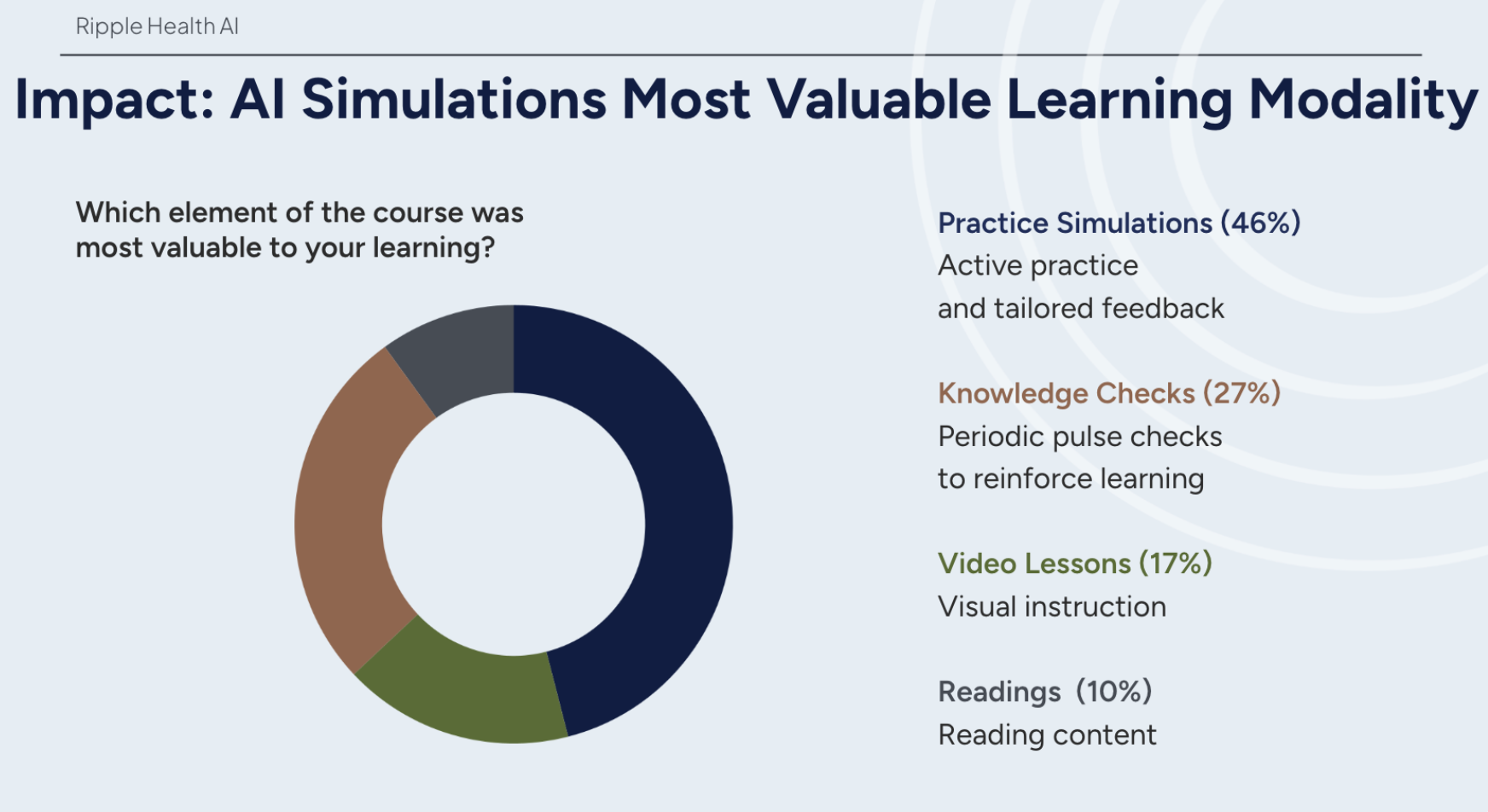
When analyzing what made the curriculum so impactful, the learner verdict was unanimous: the AI-powered practice simulations were the single most valuable element. Students consistently shared that the scenarios felt remarkably authentic, making them feel as though they were interacting with a real, live patient rather than a software interface.

A Four-Pillar Framework for Transforming the Pipeline

1. Undergraduate Nursing Education: Building the Foundation

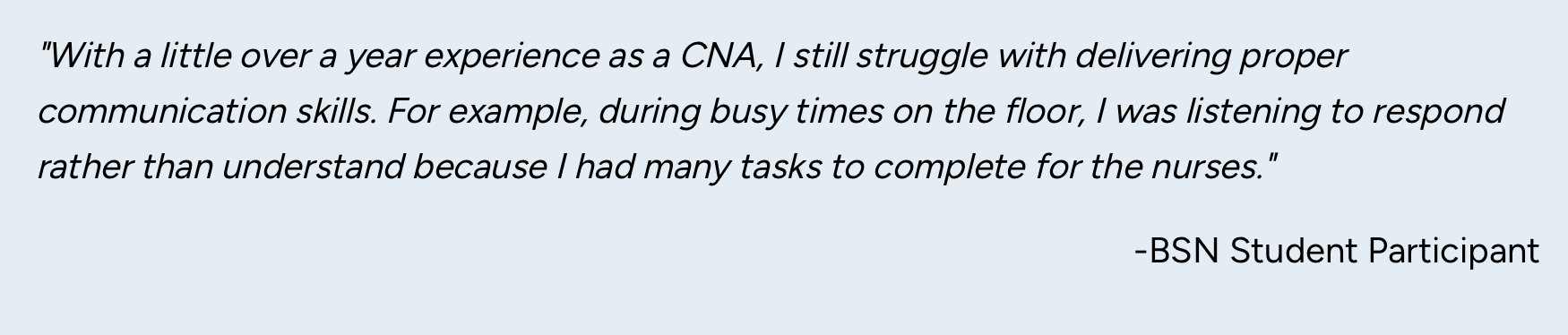
When nursing students enter clinical rotations, they are often overwhelmed by technical data. However, translating a clinical spike in blood pressure into a clear, actionable directive to a busy physician requires a completely different cognitive skill set.

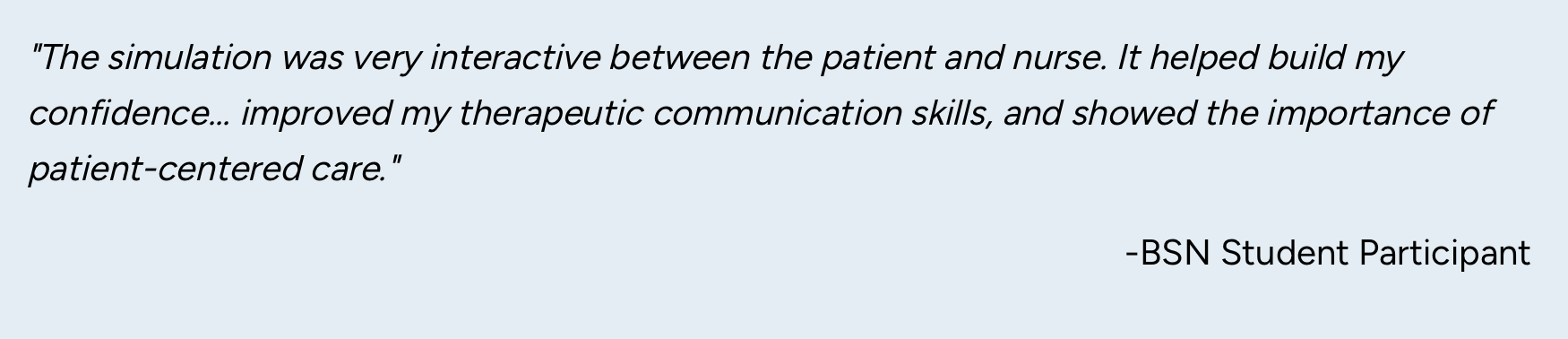
Structured communication training acts as an architectural blueprint for high-stress dialogue. Experiential student feedback from the pilot confirmed that practicing in these safe, AI-simulated environments directly targets this gap, leaving students with an immediate boost in therapeutic communication skills and a deeper appreciation for patient-centered care. When students learn how to navigate realistic scenarios early on, they enter our hospitals equipped to cut through clinical noise - mitigating preventable medical errors before they ever reach the bedside.

2. New Graduate Nurse Training: Bridging the Transition into Practice

The transition from student to novice nurse is notoriously jarring. While undergraduate education sets the baseline, the high-stakes reality of independent practice demands targeted, ongoing communication training during the transition to practice (TTP) or nurse residency phase.

New graduates regularly cite multidisciplinary conflict and a lack of psychological safety as primary drivers for leaving the profession within their first two years. Immersive training bridges this divide by directly fostering professional confidence. As students noted in the pilot, interactive practice helped them understand the direct line between therapeutic dialogue and safer clinical outcomes. Teaching new graduates to navigate workplace friction, manage difficult patient interactions, and advocate assertively for safety under real-world pressures dramatically reduces role confusion and stabilizes early-career job satisfaction.

3. Elevating the Patient Experience

Patient satisfaction is intimately tied to how care is delivered across all stages of a nurse's career. Research indicates that patients and caregivers evaluate a nurse's empathy, active listening, and presence just as heavily as their technical competence.

Formal communication interventions help both students and new graduates cultivate emotional intelligence and rapport. Participants in the training remarked that the realistic nature of the AI simulations gave them a clearer vision of how to provide better, more empathetic care in their future clinical placements. By maintaining this training standard through their first year of practice, we accelerate nurse-patient trust, directly improving post-discharge compliance, care quality, and patient satisfaction scores.

4. The Faculty and Mentor Imperative: Leveraging Technology for Success

We cannot expect students or new graduates to master complex professional dialogue if their instructors and clinical preceptors are not explicitly equipped to teach it. Communication training is highly nuanced and requires dedicated institutional support.

Shifting from traditional lecturing or passive monitoring to advanced simulation requires the right tools. Educators and preceptors must leverage specialized technology to complement training, fostering psychological safety, evidence-based feedback, and supportive, zero-risk environments where learners can safely fail, iterate, and grow without the pressure of live clinical stakes.

The Strategic Next Step for Leaders

We can no longer afford to treat communication as an innate trait that clinicians will simply "pick up" on the floor. It is a highly technical, trainable competency that must be built in school, reinforced during onboarding, and evaluated regularly.

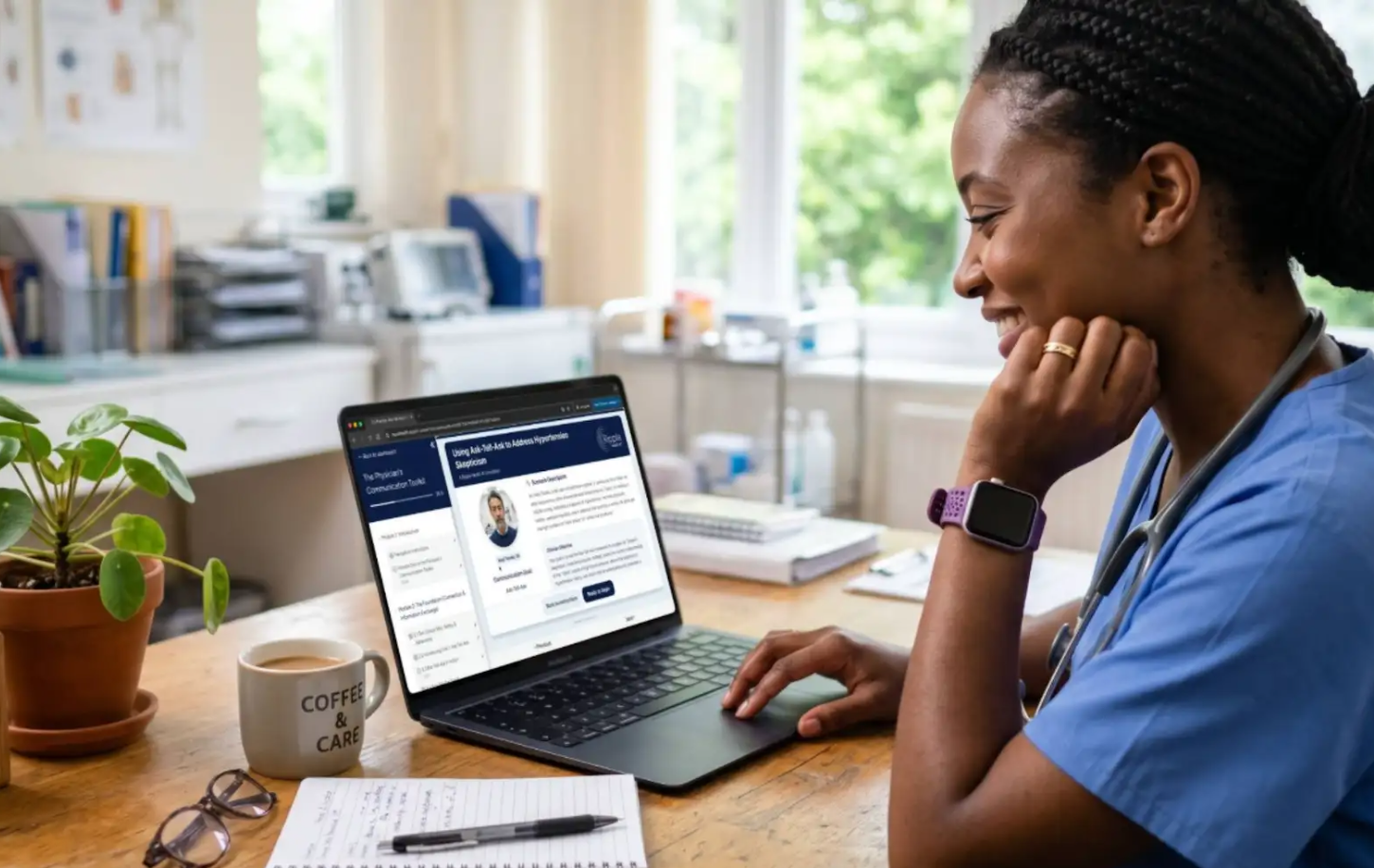
Ripple Health AI offers personalized, AI-driven learning experiences that deliver individualized, actionable feedback in real-time. Our scalable technology solutions tailor directly to your institutional specifications, aligning clinical expertise with essential interpersonal skills to ensure the next generation of your nursing workforce is both confident and competent.

As healthcare and academic leaders, investing in robust communication simulation is our clearest path forward. By securing the communicative readiness of our students and new graduates today, we ensure safer clinical outcomes, stronger team retention, and a higher standard of care for tomorrow.

Request a Ripple Health AI Demo

References

  • Arrogante, O., Ortuño-Soriano, I., & Fernandes-Ribeiro, A. (2025). Attitudinal shifts toward communication skill development in first-year nursing cohorts via high-fidelity simulation: A quasi-experimental analysis. Clinical Simulation in Nursing, 101.

  • Cho, H. and Steege, L.M. (2025). Authentic Leadership, Psychological Safety, Missed Nursing Care, and Intention to Leave Among Hospital Nurses. Int Nurs Rev, 72: e70065. https://doi.org/10.1111/inr.70065

  • Lyu, XC., Huang, SS., Ye, XM. et al. (2024). What influences newly graduated registered nurses’ intention to leave the nursing profession? An integrative review. BMC Nurs 23, 57. https://doi.org/10.1186/s12912-023-01685-z

  • Mercan, N., Coskun, S., & Apaydın Demirci, Z. (2023). Efficacy of a communication skills training for nursing students: a quasi-experimental study. J Psy Nurs, 14(3), 200-209. https://doi.org/10.14744/phd.2023.02438.

  • The Joint Commission. (2025). Sentinel Event Data 2024 Annual Review. https://digitalassets.jointcommission.org/api/public/content/eac7511986c0442a9c1ae04b1aa02cc0?v=ad34daa0


About the Author: Sarah K. Wells, MSN, RN, CEN, CNL is an experienced nurse career strategist dedicated to helping nurses and nurse practitioners of all experience levels and specialties achieve success in their nursing and NP journeys. Sarah founded New Thing Nurse and NTN Consults to help provide support and guidance to the nursing and healthcare community in a simple and direct format. Sarah’s vision is to foster a more supportive and fulfilled nursing world that spreads throughout healthcare and beyond.

Sarah has partnered with Ripple Health AI as a Nurse Advisor and Business Development Lead. The original version of this article appeared on the Ripple Health AI Insights blog.

Sarah is serving as a 2026 Advocacy Fellow with ANA-California, focusing on AI and equitable nurse staffing. Learn more about the 2026 ANA-California Advocacy Fellowships.


New Thing Nurse helps the nursing and NP community thrive in their careers! Join us on IG or Facebook @newthingnurse 🩺


June 18, 2026 /Sarah Wells
2026, LINKEDIN, SOCIAL MEDIA, PROFESSIONAL, NETWORKING, NEW THING NURSE, RESUME, JOB APPLICATIONS, NEW JOB, ATS, NURSE, NURSING, NURSING STUDENT, NURSE TRIBE, NURSE MOM, NURSE LEADER, NURSE CONSULTANT, NURSEING, RN, REGISTERED NURSE, STUDENT NURSE, NURSING SCHOOL, FUTURE NURSE, RNS, NURSING STUDENTS, NURSINGSCHOOL, NURSINGSTUDENT, JOB, FIRST JOB, JOBS, NURS JOB, NURSE JOB, JOB OPPORTUNITIES, JOB SKILLS, RESUME WRITING, SKILSS, HOW TO, MYTHS, TRUTH, TRAVEL, TRAVELING, TRAVEL NURSE, TRAVEL NURSING, ICU, ER, ED, ED NURSE, ER NURSE, ICU NURSE, PCU, MEDICAL SURGICAL, TELEMETRY, HOSPITAL, HOSPITAL JOB, HOSPITAL LIFE, STUDENT NURSE LIFE, MEDICAL, MEDICINE, HEALTHCARE, HEALTH, DIY, DO IT YOURSELF, JOB SEARCH, NURSE LIFE, NURSE STRONG, NURSE LOVE, LOVE, SUCCESS, SUCCESSFUL, SUCCEED, CLIENTS, CLINIC, CLINICS, COVER LETTER, INTERVIEW, INTERVIEWS, INTERVIEW ADVICE, ADVICE, INTERVIEW COACHING, INTERVIEW COACH, INTERVIEWER, JOB INTERVIEWS, JOB INTERVIEW, PAY, COMPENSATION, PAYCHECK, PAY CHECK, JOB ADVICE, NEGOTIATIONS, WAGES, WAGE, PRECEPTOR, PRECEPTORSHIP, NEW GRAD NURSE, NURSINGSTUDENTLIFE, ORIENTATION, INTENTIONS, NEW YEAR, GOALS, ADVOCACY, AI, ARTIFICIAL INTELLIGENCE, WORKFORCE BUILDING, STAFFING, NURSE STAFFING, HIRING, SCHEDULING, NEW GRAD, communication, transformation
Comment

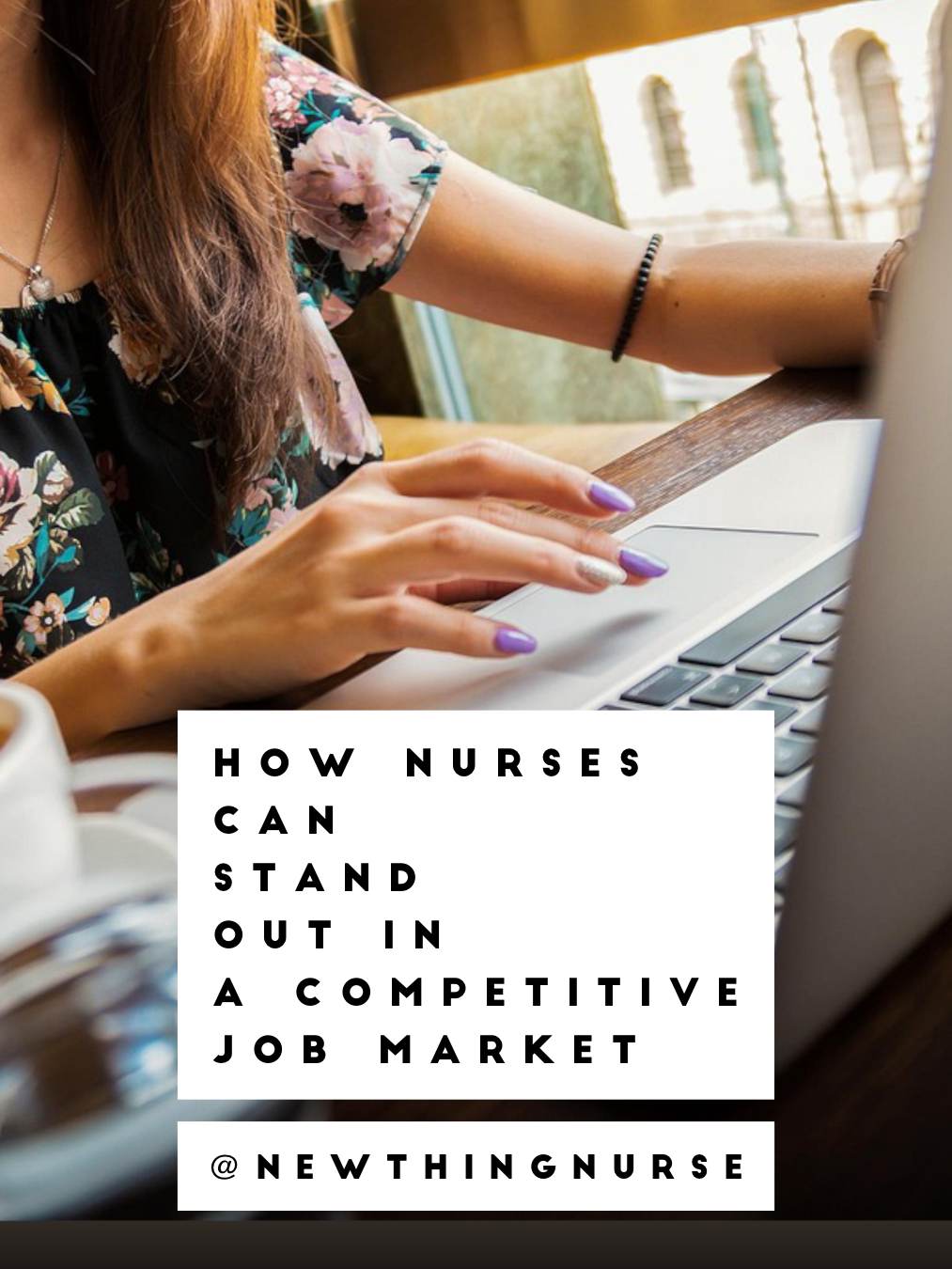
How Nurses Can Stand Out in a Competitive Job Market

May 30, 2026 by Sarah Wells

By: Sarah K. Wells MSN RN CEN CNL

Today’s nursing job market can feel shockingly competitive. While healthcare organizations continue to face staffing challenges, many employers are also receiving large volumes of applications for desirable positions. To manage this influx, organizations increasingly rely on applicant tracking systems (ATS) and artificial intelligence (AI)-enabled software to screen candidates before a human recruiter ever reviews an application.

For nurses, this means that having the right qualifications is only part of the equation. It’s equally important to ensure your application clearly communicates your value in a way that both technology and hiring managers can recognize.

Resumes are KEY

Start by carefully reviewing the job description and incorporating relevant keywords throughout your resume and cover letter. If a position emphasizes patient education, triage, leadership, quality improvement, or electronic health record experience, be sure to include those exact terms when they accurately reflect your experience. ATS software often prioritizes applications that closely align with the language used in the posting.

Next, focus on measurable accomplishments rather than simply listing responsibilities. Instead of stating that you “provided patient care,” highlight outcomes such as improving patient leading a practice change initiative, preempting or mentoring new staff, or participating in committees, councils, and quality improvement projects.

Networking = The Secret Sauce

Networking remains one of the most powerful tools in any job search. Connect with colleagues, attend professional conferences, engage with nursing organizations, and maintain an active LinkedIn presence. Personal connections can help your application get pulled from a sea of digital submissions.

Stand out from the crowd!

Technology may influence the hiring process, but authentic experience, strong professional relationships, and a well-crafted applications remain the keys to standing out as a nursing candidate.


Need help with your resume?

Check out the New Thing Nurse Winning Nurse Resume + Cover Letter Template Series


About the Author: Sarah K. Wells, MSN, RN, CEN, CNL is an experienced nurse career strategist dedicated to helping nurses and nurse practitioners of all experience levels and specialties achieve success in their nursing and NP journeys. Sarah founded New Thing Nurse and NTN Consults to help provide support and guidance to the nursing and healthcare community in a simple and direct format. Sarah’s vision is to foster a more supportive and fulfilled nursing world that spreads throughout healthcare and beyond.

Sarah is serving as a 2026 Advocacy Fellow with ANA-California, focusing on AI and equitable nurse staffing. Learn more about the 2026 ANA-California Advocacy Fellowships.


New Thing Nurse helps the nursing and NP community thrive in their careers! Join us on IG or Facebook @newthingnurse 🩺
May 30, 2026 /Sarah Wells
2026, LINKEDIN, SOCIAL MEDIA, PROFESSIONAL, NETWORKING, NEW THING NURSE, RESUME, JOB APPLICATIONS, NEW JOB, ATS, NURSE, NURSING, NURSING STUDENT, NURSE TRIBE, NURSE MOM, NURSE LEADER, NURSE CONSULTANT, NURSEING, RN, REGISTERED NURSE, STUDENT NURSE, NURSING SCHOOL, FUTURE NURSE, RNS, NURSING STUDENTS, NURSINGSCHOOL, NURSINGSTUDENT, JOB, FIRST JOB, JOBS, NURS JOB, NURSE JOB, JOB OPPORTUNITIES, JOB SKILLS, RESUME WRITING, SKILSS, HOW TO, MYTHS, TRUTH, TRAVEL, TRAVELING, TRAVEL NURSE, TRAVEL NURSING, ICU, ER, ED, ED NURSE, ER NURSE, ICU NURSE, PCU, MEDICAL SURGICAL, TELEMETRY, HOSPITAL, HOSPITAL JOB, HOSPITAL LIFE, STUDENT NURSE LIFE, MEDICAL, MEDICINE, HEALTHCARE, HEALTH, DIY, DO IT YOURSELF, JOB SEARCH, NURSE LIFE, NURSE STRONG, NURSE LOVE, LOVE, SUCCESS, SUCCESSFUL, SUCCEED, CLIENTS, CLINIC, CLINICS, COVER LETTER, INTERVIEW, INTERVIEWS, INTERVIEW ADVICE, ADVICE, INTERVIEW COACHING, INTERVIEW COACH, INTERVIEWER, JOB INTERVIEWS, JOB INTERVIEW, PAY, COMPENSATION, PAYCHECK, PAY CHECK, JOB ADVICE, NEGOTIATIONS, WAGES, WAGE, PRECEPTOR, PRECEPTORSHIP, NEW GRAD NURSE, NURSINGSTUDENTLIFE, ORIENTATION, INTENTIONS, NEW YEAR, GOALS, ADVOCACY, AI, ARTIFICIAL INTELLIGENCE, WORKFORCE BUILDING, STAFFING, NURSE STAFFING, HIRING, SCHEDULING, NEW GRAD, artificial intelligence, networking
Comment

Powered by Squarespace