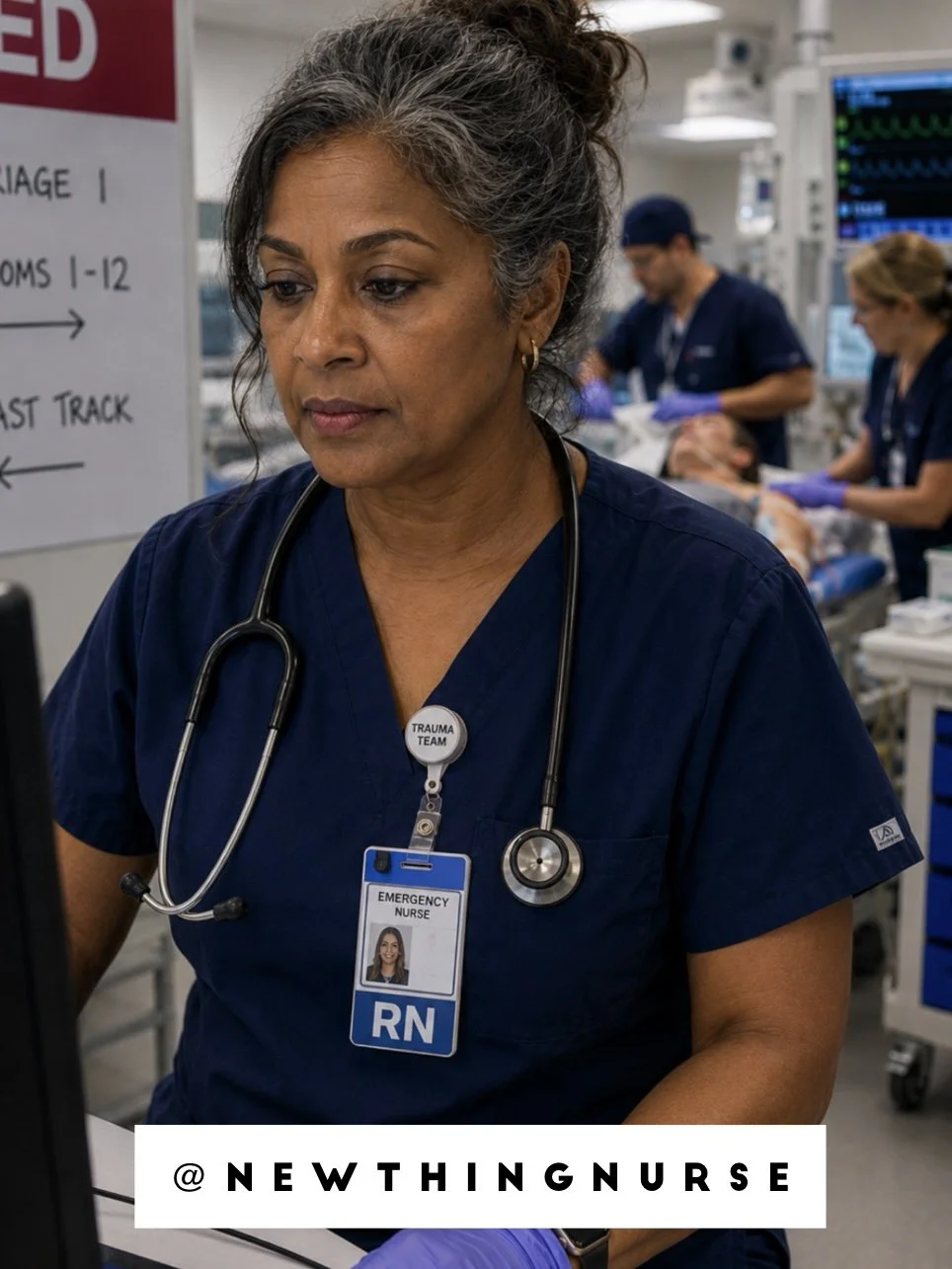
You Matter: The Worth of an Emergency Nurse
By: Kristen Cline BSN RN CEN CPEN TCRN CFRN CTRN CCRN
I see her in a corner of the Emergency Department. A small figure in scrubs that are too big, with wiry white hair that rejects a brush. She is a fixture in this community hospital, and she is checking the crash cart. She has outlasted her peers and has never worked anywhere else. She teaches full time: ACLS, PALS, NIHSS, all the letters. Her voice is low, but her eyes are sharp.
Those eyes meet mine across the busy ED. I can't stop to talk: I have two new graduate nurse residents with me. One fresh and young, full of confidence and promise who fell in love with the ED when he saw his first open thoracotomy during clinicals.
This is where I want to be.
The other, a nontraditional nursing student who spent much of her adult life in the Pre-Op unit as a CNA. She is a mom who fought for her BSN while raising two children. She knows everyone in the hospital, asks a million questions, and radiates intensity.
This is where I want to be.
I spent almost seventeen years in clinical practice as an ED charge nurse, an ICU nurse, and a flight nurse. Now that I am a clinical educator. Nurses are my patients. These two new nurses are a life-giving source of energy and hope that the whole unit can sense, fresh clean air blowing away the cobwebs. I want them to love their chosen profession, and I arm them as best I can against what’s coming: the understaffing and the moral injury, the violence and the administrative indifference, the slow erosion of conditions forcing good nurses to leave. They remind me that we can be better. We must be.
The seasoned nurse smiles. Maybe she sees in me what I see in my nurse residents. Maybe she sees the crowd of nurses she has trained over the many decades whose names she has forgotten, but who will never forget her. Does she perceive the magnitude of her life? How do we put a value on a lifetime of service? When she looks back at her long career, what does she see? Does she understand the impact she has made?
How does she know she mattered?
You matter: The Worth of an Emergency Nurse
What is the worth of a nurse? One could consider many metrics: some nurses consider the cost of their degree both in time and trials, if not merely the price of their student loans. Society has quantified the lack of nurses and called it a “nursing shortage”. A CFO’s spreadsheet might see nursing as a cost center, FTEs to optimize and eliminate.
What does a single nurse, over a 30-year span of service, contribute to the economy in objective metrics? The cumulative impact of a single bedside nurse across an entire career is scattered through a constellation of published studies. Assembled, it tells a story the spreadsheets have been missing.
The Emergency Nurse: 100,000 Patient Lives Changed
Consider an emergency nurse. Three twelve-hour shifts a week in a mid-volume ED that sees 60,000 visits a year. On a busy shift, they may treat 20 patients or more. On a quiet one, merely 12. They triage and stabilize, teach and advocate. They hold the hand of the trauma patient whose family has not arrived. They bring another back to life with muscle and will. They offer dignity with a shower and a meal to the one with nowhere else to go. 156 shifts a year. Plus overtime. An endless sea of faces who each remember the nurse who got them through the worst day of their lives, even if the name is misremembered.
Over 30 years, that nurse will care for an estimated 100,000 patients. One hundred thousand human beings touched by those hands. Some were dying. Many were afraid. Roughly 12% of them — 12,000 people — arrived with life-threatening or emergent conditions. Some of them were clinically bereft of life. The emergency nurse will participate in an estimated 500 to 1,000 cardiac resuscitations across a career.†
Not every code is a save, and not every save is during a code. Most are quieter than that. The chest pain patient in bed 4 looks gray and diaphoretic: the ED nurse gets a 12-lead before the physician has finished triage. ST elevation in II, III, aVF, an inferior STEMI. The cath lab is activated before the patient fully understands what is happening, but the nurse will talk them through. The nurse who spots the tombstones and makes that call has just bought precious more minutes of life.
Strokes are even faster. During an untreated ischemic stroke, the brain loses 1.9 million neurons every minute starved of oxygen. The ED nurse performs the stroke scale at the bedside, activates the stroke alert, and initiates the chain that gets TNK to the patient before the window closes. Neurons, counted in millions and costing days, saved or lost by the speed of the nurse's hands.
Before any of this happens, every ED visit begins with two minutes at the front door. A nurse looks at you, takes your vitals, asks why you came. They are deciding how sick you are in the time it takes most clinicians to wash their hands. Triage is the highest-stakes two-minute decision in healthcare, made thousands of times a year.
Then there is sepsis. The patient who often looks sick in a way that doesn't match their vitals yet. Tachycardic but not hypotensive. Warm but wrong. Pink and panting. The ED nurse draws the lactate, obtains cultures, gives fluids and pushes the first antibiotic while the workup is still running.
Sepsis is the third leading cause of in-hospital death. Over 30 years, one ED nurse will screen roughly 21,000 patients for serious infection and manage 800 to 3,000 confirmed sepsis cases, each one a race the patient doesn't know they might lose.
More than one in ten American deaths occurs in an emergency department. Over a 30-year career, one ED nurse will be present for roughly 210 of those deaths — about seven a year, one every seven or eight weeks. Some arrive in arrest with life long passed. Some die despite our very best. A few die in ways that stay with us for years, surfacing without warning in the shower or on the drive home.
When death wins, the ED nurse will clean up your loved one. They will change the sheets and put a fresh gown on their still form. They place warm blankets over things no one else should see. They leave a hand out above the sheets, to be held in grief. They turn the lights down low and arrange some chairs, providing coffee and crackers for your family. Someone might be hungry and the cafeteria closed long ago.
Then they call the mortuary, making the arrangements no one can yet bring themselves to contemplate. They give you a few more minutes with your loved one. It’s ok. We don’t need the room for a bit. They give you a few more minutes to pretend this is a bad dream. Once you leave, it becomes terrible and real and now life has an ‘after’.
We let you stay as long as we can.
What is that worth? A 2024 study showed that adding one additional nurse to the busiest ED day shift can shorten stays and avoid $160,000 in lost patient wages per 10,000 visits. That decrease in service times frees up capacity for treating more patients, which may can generate $470,000 in extra net revenues for the facility per 10,000 visits. The authors wrote “investing in nursing will more than pay for itself.
Unintentional injury is the leading cause of death for Americans aged 1 through 44, and the third leading cause of death overall. The 2019 economic cost of injury in the United States reached $4.2 trillion, more than half of which fell on working-age adults. Trauma is unique among acute presentations because the physiology is time-dependent in a way nothing else is. The trauma nurse holds the clock at the bedside from arrival through ICU handoff. Every minute they keep is a minute the patient remains salvageable.
That conversion is mechanical. The trauma activation alert pulls the nurse to the bay before the patient arrives. The primary survey runs in parallel with vascular access, large-bore lines, rapid infuser primed, blood at the bedside before it's needed. The nurse expertly executes the massive transfusion protocol when the surgeon calls for it, and increasingly recognizes the indication before the surgeon makes the call. Pooled data show MTP activation reduces overall trauma mortality by approximately 29%. Each minute of delay between ED arrival and operative bleeding control increases hemorrhagic-death odds by 1.8%. Across 79,000 patients in 34 ACS-verified trauma centers, VTE prophylaxis initiated within 24 hours of admission cut venous thromboembolism by more than half compared to delays beyond 48 hours. Each finding maps to a specific bedside action. Each carries a price in lives.
Pediatrics are particularly vulnerable. A national cohort study of 796,937 children treated in 983 emergency departments demonstrated that high pediatric readiness, which includes metrics such as staffing, equipment, policies, quality improvement, cut in-hospital mortality by 60% to 76%, with the benefit persisting at one year. The investigators modeled that if every ED reached the highest-quartile readiness, approximately 1,442 pediatric deaths could be averted annually. A 2024 follow-up across 417 US trauma centers found that changes in pediatric readiness from 2013 to 2021 mapped directly to changes in pediatric mortality: high-readiness EDs corresponded to 643 lives saved, while persistent low readiness corresponded to 729 preventable pediatric deaths. The pediatric emergency care coordinator role, almost always filled by a nurse, is what holds these readiness elements together at the bedside. A national program, the National Pediatric Readiness Project, is being promoted and operationalized by emergency nurses across the country.
Revenue data largely misses the point. The emergency department is America's last remaining social safety net. The Emergency Medical Treatment and Labor Act (EMTALA) requires screening and stabilization of every patient who darkens the door, regardless of ability to pay. The ED nurse performs social work, crisis intervention, intimate partner violence screening, and substance use disorder counseling. None of it appears on a hospital bill, all of which holds together what's left of the social contract.
ED often involve a mental health or substance use crisis, with wait times for boarded patients awaiting transfer to a dedicated mental health facility lasting from hours to days. During those hours, the ED nurse is the psychiatric provider: performing risk assessment, managing agitation, sitting with patients in rooms stripped of anything that could cause harm, checking on them every fifteen minutes through the night.
They do this while facing an epidemic of workplace violence: 70% of ED nurses report being physically assaulted at work, often with no repercussions and no laws to protect them. They do it anyway. They’re often told that it is simply "part of the job."
……………..
I think about the nurse with the white hair checking the crash cart. Thirty years in one emergency department. How many patients passed through her hands — fifty thousand? Eighty thousand? How many new nurses learned to read a rhythm strip because she was patient enough to teach them? How many codes ran smoothly because she had checked that cart, again, the way she always has? Steady, consistent; not glamorous but vital. Life preserving.
You matter.
Note:
† The 500–1,000 career resuscitation estimate is an illustrative calculation: roughly 292,000 adult in-hospital cardiac arrests occur annually, with about 10% in emergency departments, plus transported out-of-hospital arrests, distributed across approximately 5,000 US emergency departments.
About the Author: Kristen Cline is a Professional Development Practitioner in the Bay Areaand the founder of Regulation Loop LLC. Her clinical career spans 20 years across emergency, ICU, and flight nursing, including service as a Trauma Program Manager. Her published work appears in Annals of Emergency Medicine, the Journal of Emergency Nursing, the Bulletin of the Atomic Scientists, KevinMD and several major nursing textbooks and serves on the editorial board of Air Medical Journal.
Follow Kristen Cline:
Email: kristen.cline@gmail.com
LinkedIn: linkedin.com/in/kristen-m-cline
SubStack: kristencline1033.substack.com
New Thing Nurse helps the nursing and NP community thrive in their careers! Join us on IG or Facebook @newthingnurse 🩺